
Automating the Unautomated: Inside Ethos Automation’s Tier 1 Automotive Manufacturer Liftgate Assembly Cell
When a Tier 1 automotive supplier approached Ethos Automation, the goal wasn’t simply faster production—it was something far more ambitious: to fully automate a liftgate assembly process that had never been automated before, and to do it with a robotic system flexible enough to outlive the program it was built for.
Reimagining a Fully Manual Process
The existing liftgate assembly line relied heavily on manual labour, with up to twelve operators handling component loading, assembly, and quality control. Seven components were assembled by hand, and production output was directly tied to headcount and human consistency—both of which naturally limit scalability and repeatability.
Ethos was tasked with transforming this entire workflow into a fully automated system. The targets were strict: sub-14-second cycle time, the ability to handle left- and right-hand variants across two models, a compact footprint, and a tight delivery timeline.
But the most important requirement shaped everything else: the customer didn’t want fixed automation. They wanted robots—reusable, reprogrammable assets that could be redeployed long after the current vehicle programs ended.
Engineering a 12-Robot System
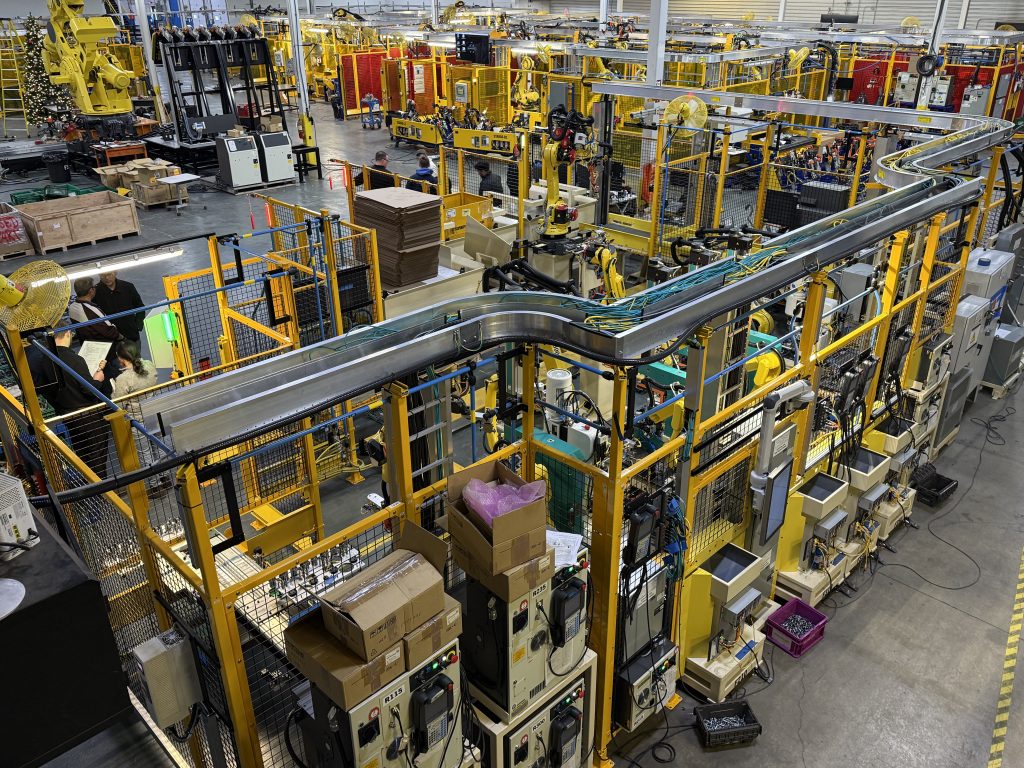
To meet these demands, Ethos designed a highly integrated cell using twelve FANUC robots, each assigned a specific role within the assembly sequence.
- Compact high-precision robots handled small components such as bushings, rings, and pins with consistent accuracy.
- Mid-sized industrial robots performed heavier loading, orientation, and transfer tasks between stations.
- Large multi-purpose robots managed complex operations including part-to-part transfers, inspection sequencing, torque testing, vision verification, and final packaging.
One of the most advanced functions was the packaging system, where finished parts were placed dynamically into shipping bins without fixed locating features—allowing flexibility across part variations.
Solving the Tolerance Stack-Up Challenge
One of the most complex engineering problems came from cumulative manufacturing tolerances. While each individual component stayed within spec, combining four parts—each at the edge of their tolerance range—created unpredictable variation that traditional automation struggles to handle.
Ethos had to design tooling capable of absorbing these extremes while still maintaining speed, accuracy, and repeatability. This became one of the defining mechanical challenges of the entire project.
The Delicate Conductivity Ring Problem
A particularly difficult issue arose with ultra-thin conductivity rings that could easily deform during handling. Minor inconsistencies caused them to shingle together or misfeed in the system.
Ethos solved this through a combination of mechanical redesign and controls adjustments:
- A precision adjustable gripper stop ensured consistent compression during pick-and-place.
- Conveyor timing was modified to eliminate vibration during pickup.
- A magnet system was added to ensure parts consistently settled into the same position before robotic pickup.
Together, these changes stabilized what was originally an unreliable feeding station.
Integrating a Fully Connected Control System
The control architecture tied together robots, servo presses, riveters, torque testers, vision systems, and packaging—all coordinated through a single PLC-based system.
The challenge wasn’t just making each system work, but ensuring they all worked together seamlessly within a sub-14-second cycle. Synchronization and communication across all devices were critical, with zero tolerance for sequencing errors.
Delivered Under Pressure
Midway through the project, the timeline was pulled forward by eight weeks, requiring Ethos to complete integration and commissioning directly at the customer’s facility instead of in-house.
Despite the added pressure, the team resolved real-world production issues on-site, refining tolerances and stabilizing the system under live conditions until it ran reliably.
Results That Exceeded Expectations
Today, the system is fully operational and exceeds its original performance target, producing over 1.42 million liftgate assemblies annually.
What once required up to twelve operators now requires just one person to load raw components, with the rest of the process fully automated.
The robotic system is also already being considered for further evolution—potentially removing the final manual touchpoint to achieve fully lights-out production.
A New Standard for Robotic Manufacturing
This project demonstrates what’s possible when robotics, mechanical design, and controls engineering are fully integrated from the ground up. Ethos didn’t just automate a process—they engineered a flexible manufacturing platform designed for long-term adaptability.
Want to see the full technical breakdown?
Explore the complete case study here:
Tier 1 Automotive Manufacturer Case Study
About Ethos Automation:
Ethos Automation is an automation systems builder and robot integrator based in Brantford, Ontario. The company has been building custom machines, robotic welding automation and material handling systems since 2018. Ethos automation serves automotive, consumer, and industrial markets across North America.
Company contact: Richard Arts, Director of Sales & Marketing | Richard.Arts@ethosautomation.com