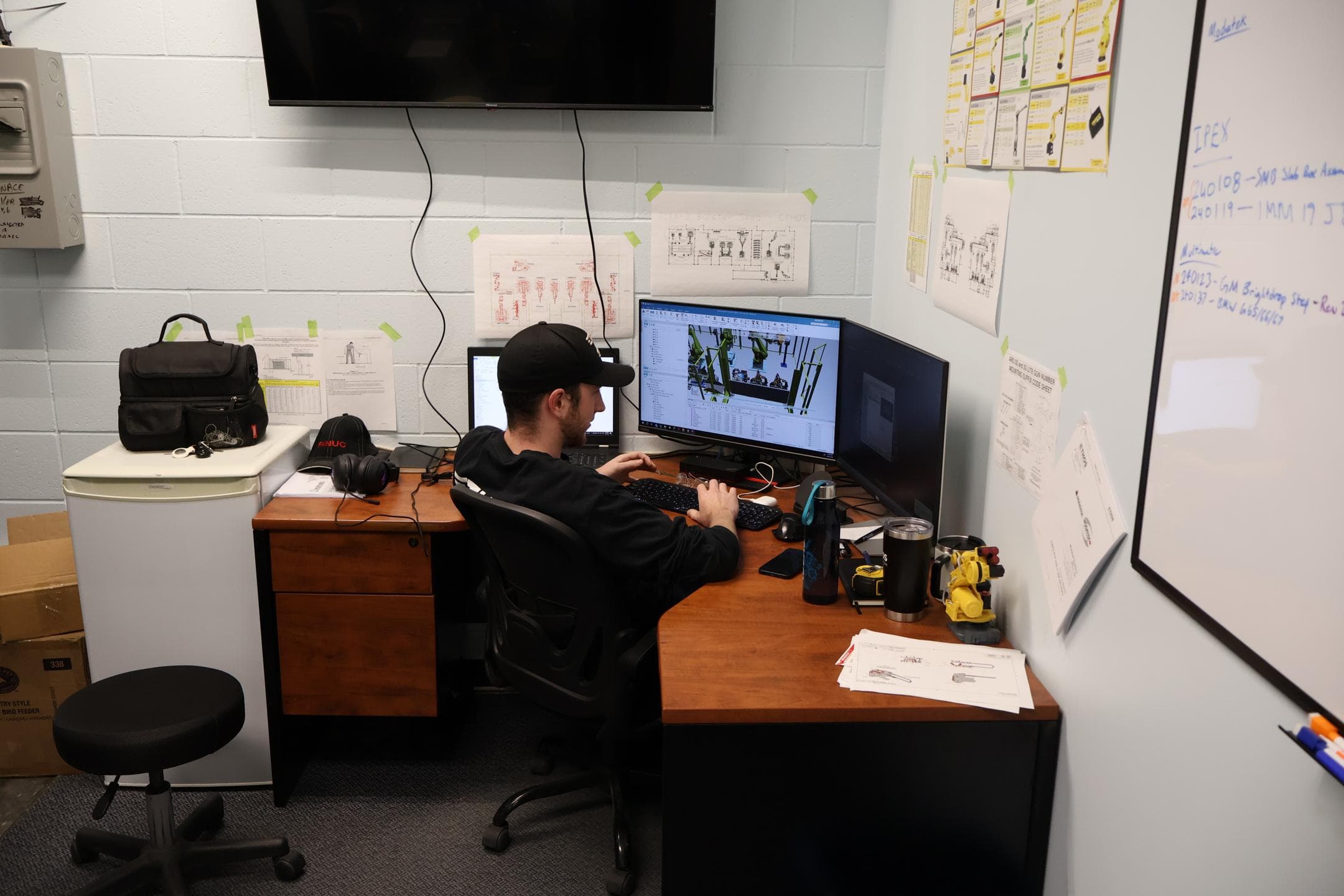
- Concept and layout.
- Cell arrangement, part flow, operator and maintenance access, guarding and safety zones. Reach studies before anything is committed, not after.
- Simulation before steel.
- We model reach, cycle, and interference in software, and we run cycle-time studies against your real rate. Simulation is also what makes change survivable: when an interface shifts mid-project, a modelled cell gives you a structured way to work through the new configuration instead of starting again.
- Custom fixtures.
- Locating and clamping that holds the part correctly through the whole process, including when the part arrives at the edge of its tolerance rather than the middle of it.
- End-of-arm tooling.
- Grippers, vacuum, magnetic, and multi-function tools. Tool changers where one robot has to do more than one job. EOAT is where most cells are won or lost, and it is the component most often left to the end.
- Design for tolerance stack-up.
- Every component has a tolerance band. When several components in an assembly arrive near their limits at the same time, the cumulative stack can push the assembly outside what standard tooling accommodates. In volume production that is not an edge case, it happens regularly. Designing tooling that absorbs the full envelope while holding repeatability and cycle time is real engineering, and it is the work that separates a cell that runs from one that runs on Mondays.
- Design for maintenance.
- If a part of the machine will be serviced, it has to be reachable. On one aerospace cell we put all three robots in below-floor pits specifically so maintenance vehicles and people kept their access to the cell during production.