
All capabilities

ENGINEERED AROUND YOUR PROCESS

Process Development & R&D

For the parts nobody has automated yet. Trials, prototype tooling, and proof before anyone commits capital to a machine.

Discuss your application
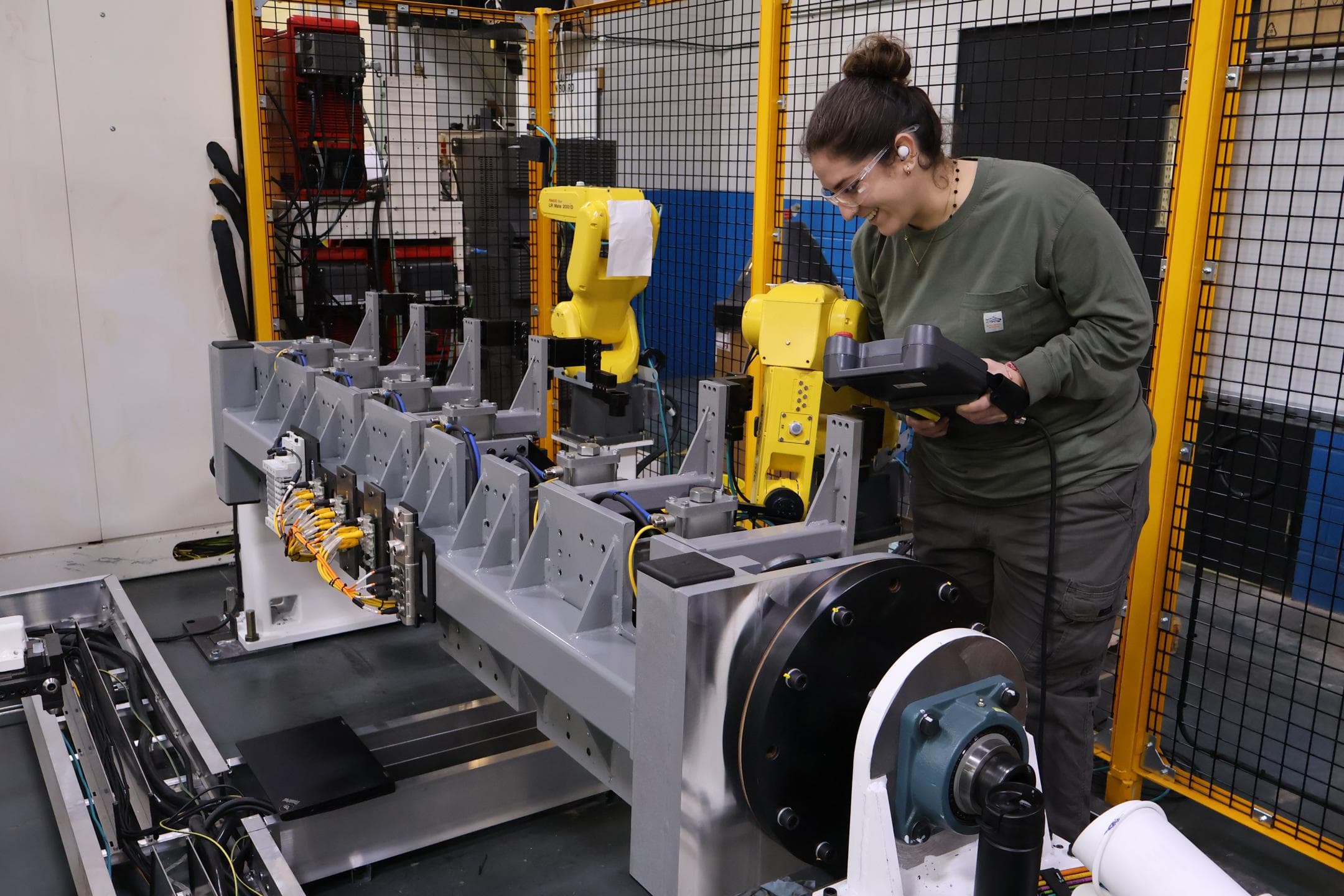
Ethos engineering and shop-floor work supporting process development & r&d
ENGINEERING IN PRACTICE / INSIDE ETHOS

The problem this solves

Some processes have been automated ten thousand times and the engineering is a known quantity. Yours might not be one of them.

The part is delicate, or flexible, or it nests unpredictably in a bin. The pick has never been done reliably by a machine. The process depends on something an experienced operator feels rather than measures. Nobody can tell you the cycle time because nobody has run it.

The expensive failure mode here is well understood and still common: design a machine around an unproven process, build it, and discover during commissioning that the assumption at the centre of it does not hold. Now you are solving a research problem on a fabricated machine with a customer waiting.

Process development moves that discovery to the cheapest point in the project.

What we actually do

Feasibility trials on your real parts.
Not prints, not models, not a similar part. Physical parts from the same production you intend to run.
Prototype tooling and grippers.
Built quickly, deliberately not production-grade, to answer one question at a time. The purpose is learning, and a prototype that proves an approach wrong in two weeks has done its job.
Difficult pick development.
Parts that are flexible, fragile, magnetic, oily, nested, or presented inconsistently. This is where most automation projects actually fail, and it is the most common reason we get called before anyone has drawn a machine.
Cycle-time proving.
Establishing a real number you can build a business case on, rather than a number derived from a catalogue.
Simulation and reach studies.
Modelling the cell before steel. This is also what makes a project survivable when something changes mid-stream: a modelled cell gives you a structured way to work through a new configuration instead of starting again.
A written answer at the end.
What works, what does not, what it costs, and what we would build. Including when the honest answer is that automation is not the right investment for this part yet.

Proof

Proving a cell with live aerospace parts

On an aerospace material handling project, proving out the cell required actual parts from the same programs the machine would run. Fifteen variants across three aircraft programs.

Getting them was its own project inside the project. Pulling production parts for testing meant temporarily removing them from a floor that still had orders to fill. Parts were tracked on both sides and some were held off the production floor specifically for our use.

That prove-out is where the robot programming met real hardware. Each variant needed verified pick positions, validated orientation sequences, and confirmed clearances. Simulation gets you close on all three. Only live parts confirm them.

A challenge that arrived in the parts bin

On a high-volume automotive assembly line, not every problem originated in the machine. One of the components, a conductivity ring, behaved in ways that only showed up once it was being handled at rate.

That is the argument for this phase in one sentence. The things that break automation projects are frequently not in the specification, and you find them by running parts, not by reviewing drawings.

How this usually runs

A short, scoped engagement with a defined question and a defined deliverable. Not an open-ended research contract.

Typical shape: you send parts, we run trials against a specific question, you get a written answer and a recommendation. If it proves out, that work rolls directly into the machine design and nothing is wasted. If it does not, you have saved the cost of a machine built on a wrong assumption.

Starting a conversation

  1. The part, and ideally a handful of real ones including the awkward examples.
  2. The specific question you need answered. “Can this be picked reliably” is a good question. “Can this be automated” is too broad to price.
  3. What decision is waiting on the answer, and when.

THE NEXT MOVE IS YOURS.

What could we
build together?

Bring your part, your process, or the problem you haven’t solved yet.

Download the capability sheet One page. No form.

LET’S TALK