
You cannot weld aluminium to hot-formed steel.
That sentence is the whole problem. For a century the automotive industry has joined car bodies by melting two pieces of similar steel together, and almost everything about how a body shop works descends from that one process. Then battery weight arrived, and with it the need to take mass out of every structure that is not the battery, and the cheapest way to build a strong, light part became making it out of four different materials at once.
Which leaves you holding an assembly that cannot be welded.
One Part, Five Materials
The customer is a major Tier 1 automotive supplier. The part is a side sill — the long structural beam running along the bottom of a car between the wheels, carrying the A, B and C pillars, and in an electric vehicle bolting directly to the battery tray that forms the spine of the car. In a crash it is one of the things standing between the battery and whatever hit it.
It is made in left- and right-hand pairs. Sixty-six parts per hand, a hundred and thirty-two per vehicle, twenty of them unique.
The main member is an aluminium extrusion, 2360 mm long, 24.5 kg, arriving already e-coated. Attached to it: an A-pillar in 1.4 mm hot-formed steel, a B-pillar in 1.5 mm high-strength galvanised steel, a C-pillar in 0.65 mm high-strength low-alloy steel, brackets in a stainless variant, structural adhesive, heat-expandable tape, and three separate families of fastener.
Aluminium and steel do not weld to each other. Different melting points, brittle intermetallic compounds at the joint, and galvanic corrosion wherever the two touch in the presence of moisture. Every one of those is a reason not to melt them together.
So the line does not melt anything.
Three Ways to Join Instead
Each pillar is attached by a different combination, chosen for its materials, its thicknesses and the load it carries.
The A-pillar gets 1570 mm of structural adhesive in a 3 mm half-round bead, five flow drill screws, and two strips of heat-expandable tape laid on the extrusion before the pillar goes down — the tape expands later in the paint oven to kill vibration between the two metals.
The B-pillar gets 240 mm of adhesive and eight self-piercing rivets.
The C-pillar gets 260 mm of adhesive and four self-piercing rivets, of a different type from the B-pillar's.
Adhesive is doing more work here than it sounds. It is not a backup to the mechanical fasteners; it carries structural load, spreads stress a point fastener would concentrate, and seals the aluminium-steel interface against the galvanic corrosion that would otherwise eat the joint from the inside.
Drilling a Hole That Was Never There
A flow drill screw makes its own hole, its own thread and its own joint in one motion, from one side.
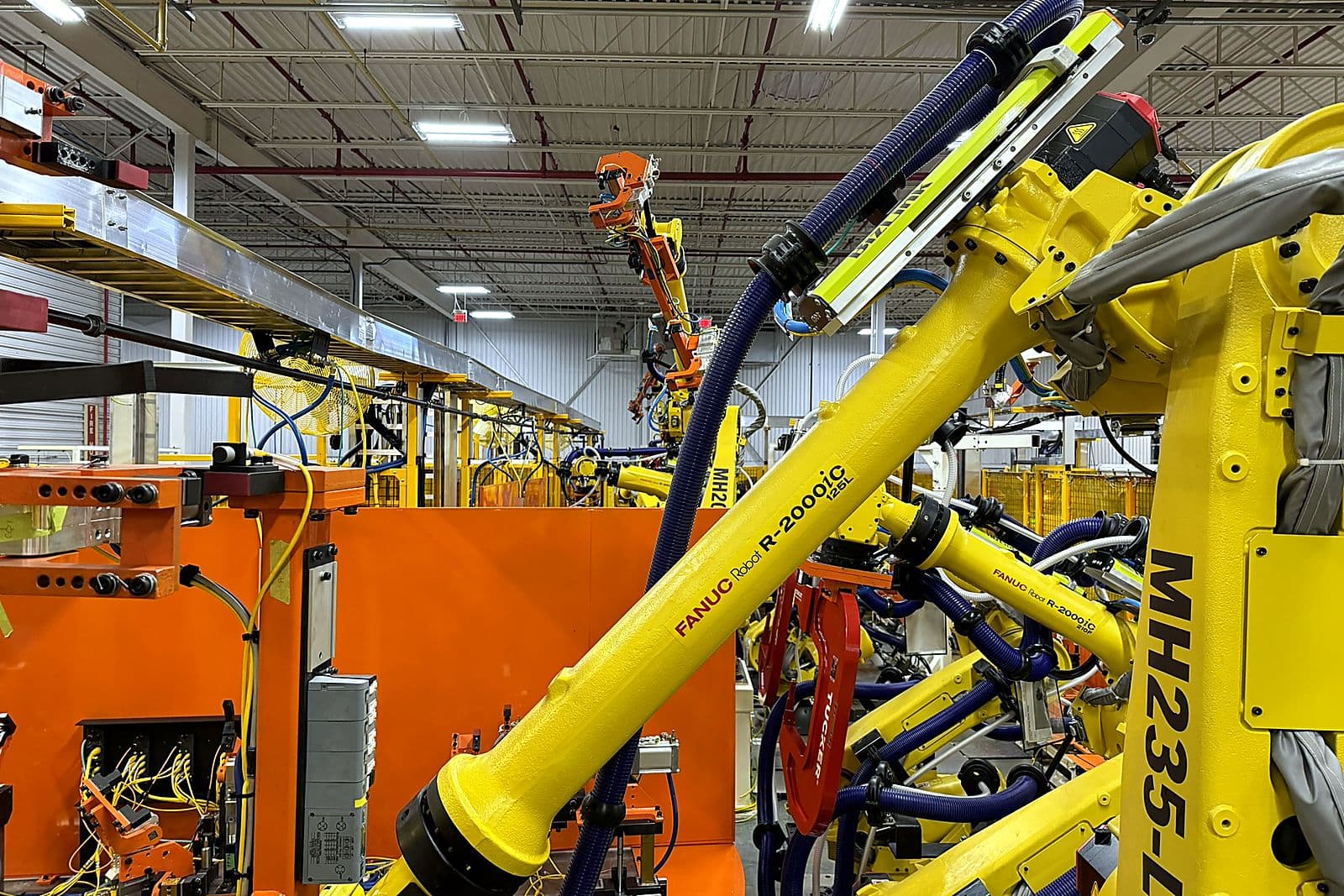
The screw spins at up to 5000 rpm with 675 lbf (3,000 N) pushing down on it. Friction heats the metal until it softens; the screw penetrates; displaced material extrudes into a collar around the shank; threads form in that collar without cutting a chip; the screw pulls the second sheet tight into the first and torques down. Four robots on the line carry Atlas Copco flow drill systems to do it.
No pre-drilling. No punching. No access to the back of the part — which matters enormously, because the inside of a closed extrusion is somewhere no tool will ever reach.
Holding a Part You Are Not Allowed to Touch
That 675 lbf has to go somewhere. The part has to be held still against it, which means clamped hard.
The extrusion arrives e-coated, and it is a Class A surface — visible on the finished vehicle. It cannot be marked. Not scuffed, not dented, not witnessed, anywhere, by anything.
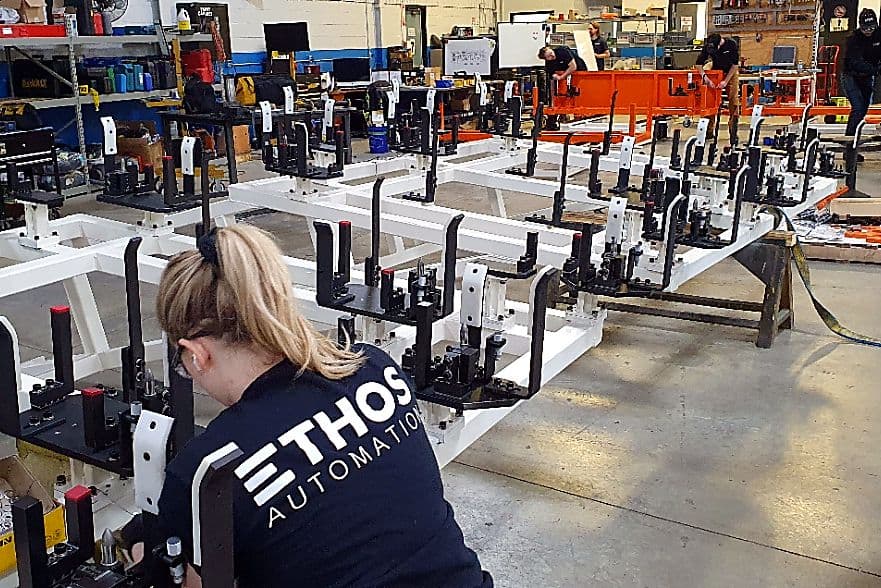
So every clamp pad and net pad that touches it was machined out of tool steel, had half an inch removed from the face, and was dipped in polyurethane to put that half inch back. Full clamping force, steel rigidity underneath, and nothing in contact with the coating that can mark it.
Locating pins were sized 0.15 mm under minimum material condition at a tenth-thou tolerance, from a stack-up study — tight enough to hold the assembly true, loose enough that an operator can actually drop a part onto them a few hundred times a shift.
And once the joining is done, most of those pins retract. As sub-components become one assembly they inherit each other's datum holes, and a part held on too many pins is over-constrained — a robot trying to lift it out can over-torque a joint servo. Shot pins pull back so only two locating pins remain engaged, and the part lifts clean.
Punching Without Punching Through
A self-piercing rivet joins a stack without a pre-made hole either, and without going all the way through.
The rivet is driven into the top sheet, pierces it, and then — instead of exiting the bottom sheet — is forced outwards by a die underneath, flaring into the bottom material and locking mechanically. The bottom sheet deforms but is never broken. It stays sealed, so there is no path for corrosion, and the joint holds by mechanical interlock rather than friction. Two robots carry Stanley Engineered Fastening rivet systems.
The trouble is that everything determining whether that joint is good happens inside the metal. Interlock distance, remaining bottom-layer thickness, head flushness: invisible once the rivet is set, and conventionally measured by cutting the joint in half and photographing it under a microscope.
You cannot do that to a part you intend to ship.
Nobody Had Written the Specification
Here is the part that does not appear in any brochure.
For two of the three components being flow drilled, no joint specification existed. Not "existed but needed adapting" — there was no data. Nobody had published what a good joint looks like in that particular stack of materials at those thicknesses, because nobody had needed to before.
So the automation team derived it. They took what specifications did exist, worked with the equipment supplier, and established the requirements for the additional applications themselves — what torque, what engagement depth, what constitutes a joint that passes.
The same was true of the technology generally. Flow drilling and self-piercing riveting were both new to Ethos on this job. The suppliers sat with the programmers to teach the interfaces and establish baseline parameters, and the team worked from there to a stable process. That is worth saying plainly rather than implying a mastery that arrived later: the first time anyone does this, they are learning it.
Then the product changed underneath them. A late CAD release lengthened the flow drill screws from 21 mm to 25 mm and specified a harder material to drive them into. Every stud location needed an entirely new torque profile, created and trialled from scratch, on equipment that had to be converted to suit.
Measuring the Making, Not the Result
Because none of these joints can be inspected afterwards, the line was built to measure the process instead. If the making of the joint was right, the joint is right, and the evidence has to be captured at the moment of making.
Every flow drill screw has servo feedback on rotation and on linear travel, watching torque against engagement depth across the whole cycle. Every rivet has force, displacement and velocity monitored through the stroke. Every adhesive bead is measured in flight by a Coherix laser checking volume, width and position 400 times a second against the programmed path, before anything is laid on top of it.
All of it lands against the part's serial number. Each assembly leaves the line carrying a record of how every joint in it was actually made.
And the cell will not let a bad one through. A screw that misfeeds triggers up to three reloads before calling an operator. Rivet boxes stay RFID-locked until the feeder confirms the right rivet type, because the B-pillar and C-pillar take different rivets and swapping them produces a joint that looks perfect and is not. Adhesive drums are barcode-scanned at the pump and the system refuses to dispense past the expiry date. A timestamp starts the moment a bead is laid, and any part not closed out within thirteen minutes is rejected automatically.
Black Tape on a Black Part
The best problem on this job was also the smallest.
Two strips of noise-cancelling tape go onto the extrusion, and the cell has to confirm they are there before it will proceed. In CAD this looked trivial: the tape rendered blue against bare aluminium, an easy contrast for any camera.
In reality the extrusion arrives e-coated black. And the tape is black.
The automation team worked through lenses and camera settings until they found the thing that separates them — not colour, but finish. The tape is dull; the e-coat is glossy. Tuned for that, the camera sees the difference reliably.
It is a small story and it is the honest texture of this kind of work. A detail invisible in the model becomes a week of trials on the floor, and the answer is not more technology, it is noticing that one surface reflects and the other does not.
A Product That Would Not Sit Still
By the end of 2023 the job carried twenty-one engineering changes, a large share of them because the customer's own customer kept revising the part after tooling had been cut.
Datum holes in the main extrusion shrank from 13.5 mm to 8.5 mm, so locating pins were redesigned, remade and reinstalled. An additional projection stud and weld nut were added to the A-pillar, and that one cascaded: the hole the nut welds into is stamped before the part is formed, so its position is not identical part to part. Finding it reliably meant adding a vision station whose only job is locating that hole, two more material handling robots, redesigned end-of-arm tooling for weld access, hand-off tables, a fresh simulation, and extra error-proofing across three stations on the main line.
There was also a genuine surprise. Tooling for one station had been designed around new equipment, with the vendor's support — and when the equipment arrived, the product orientation was 180 degrees from what it needed to be. Redesigning that fixture properly would have forced redesign of four more downstream. Instead the team added a flip station that turns the part back to its original orientation, containing the damage to one station instead of five. It cost about four hundred engineering hours. It saved considerably more.
Three Things That Had Nothing To Do With Joining
All of the above is the novel engineering. None of it is what decided whether the line would hit its number.
A forklift did. The outgoing rack holds thirteen parts. Ethos ran a timed study at the customer's own plant and found the average turnaround for a driver to pull a full rack and set an empty one was 7.6 minutes. On a single rack the line would stop twice an hour for a combined 15.2 minutes, capping output at 39 parts an hour and landing 34.56% below the efficiency target. Nothing about the robots would have fixed that. So every incoming and outgoing position was doubled. The robot takes just over thirteen minutes to fill one rack; the driver needs less than eight to swap the other. The line never waits for a forklift.
A gripper that would not fit did. The end-of-line robot has to move a part from automated inspection to a manual inspection station to the shipping rack, all inside the cycle — and the manual station has to be emptied before it can be refilled, which eats into the time an operator has to actually look at the part. The textbook answer is a dual end effector that holds one part while picking another. It was not available here: payload was already at the limit and a dual tool physically could not enter the finished goods rack. So the team built two identical manual inspection stations and had the robot alternate between them. One is always empty and ready; the other always holds a part being inspected. Floor space bought back what payload could not.
A light beam did. An operator loads the turntable, palms out, and clips the vertical light curtain on the way past. The turntable stops mid-rotation. Because the table itself is the guard when fully rotated, a half-rotated table means the cell is open — which means an emergency stop of the entire zone. Seven robots, hard stopped, because somebody brushed a beam walking away. Repeated e-stops wear mechanical components and destroy the availability the whole line was sized around.
The fix was a second set of light curtains, horizontal, inside the operator zone. Now a brush against the vertical curtain only stops the turntable. The full emergency stop is reserved for someone genuinely crossing into the cell. It is not typical practice, and it exists because somebody thought through what an operator actually does rather than what the standard assumes.
What It Was Built To
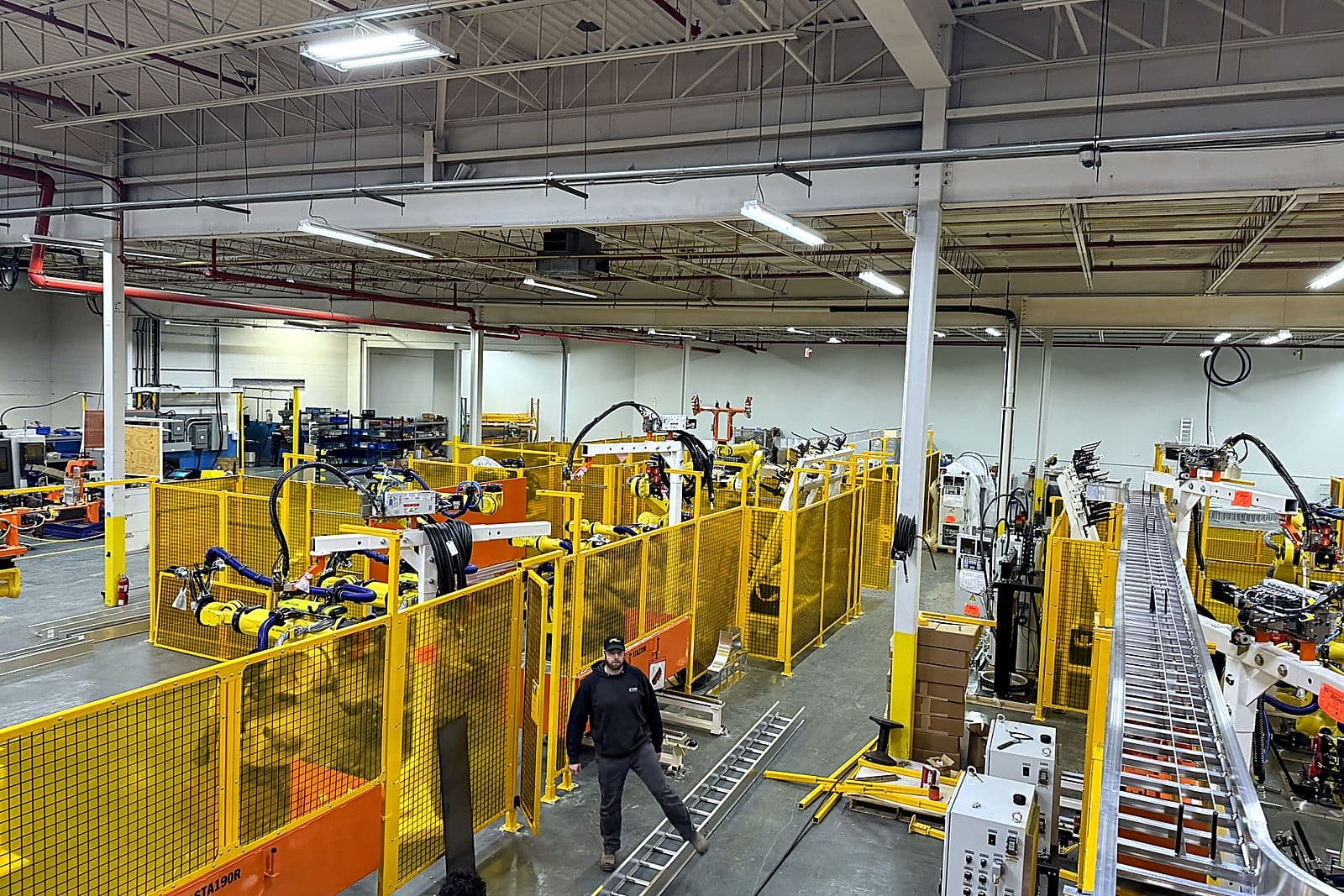
Two complete mirrored lines. Twenty-two robots. Seventeen stations each. A cycle time of 60.4 seconds, derived from an annual volume of nearly 296,000 vehicle sets across three shifts at 85% efficiency. Quality capability of 1.67 PpK on a thirty-piece run and 1.33 Cpk at rate.
The line was built. It was certified. The fixtures were shimmed and dimensionally reported, station by station, side by side, left hand and right. It was bought off on Ethos's floor and it met every metric it had been contracted to meet.
The Line That Never Ran
In 2024, the vehicle programme was cancelled.
Not the line. The line was finished and working. The programme it was built for was called off upstream, part of a broader retreat across the industry from the electric vehicle volumes everyone had forecast three years earlier. The customer had ordered a line to build a part for a car that was no longer going to be made.
It was never installed. It never ran a production part. Two complete assembly lines, twenty-two robots, four joining technologies and eighteen months of engineering, signed off as meeting every requirement, and the number of finished assemblies they have shipped to a customer is zero.
There is no version of that which is not a hard thing to write down.
What It Was Worth Anyway
It is worth being honest about what that does and does not change.
It does not change whether the engineering was right. The joints were sound, the process monitoring worked, the cycle time was met, the safety case was complete and independently calculated. A machine that is switched off is not a machine that failed. The verification happened, the numbers were real, and the metrics were hit in front of the customer.
What it changes is who gets the benefit. Nobody on that programme does.
But the knowledge did not evaporate with the programme. Somebody on this job worked out what a sound flow drilled joint looks like in a material stack nobody had specified. Somebody worked out how to see black tape on a black part. Somebody worked out how to clamp a Class A surface at six hundred pounds of force without leaving a mark, and how to contain a 180-degree surprise to one station instead of five. None of that was in a manual at the start and all of it is in the building now.
Multi-material joining is not going away — it is what every lightweight structure in every electric vehicle requires. The number of integrators in North America who have built a production line doing adhesive, flow drill screws and self-piercing rivets to automotive standards, and proven it, is small. Ethos is on that list because of this job.
That was not the return anyone wanted. It is, however, the return that was available, and it is not nothing.