
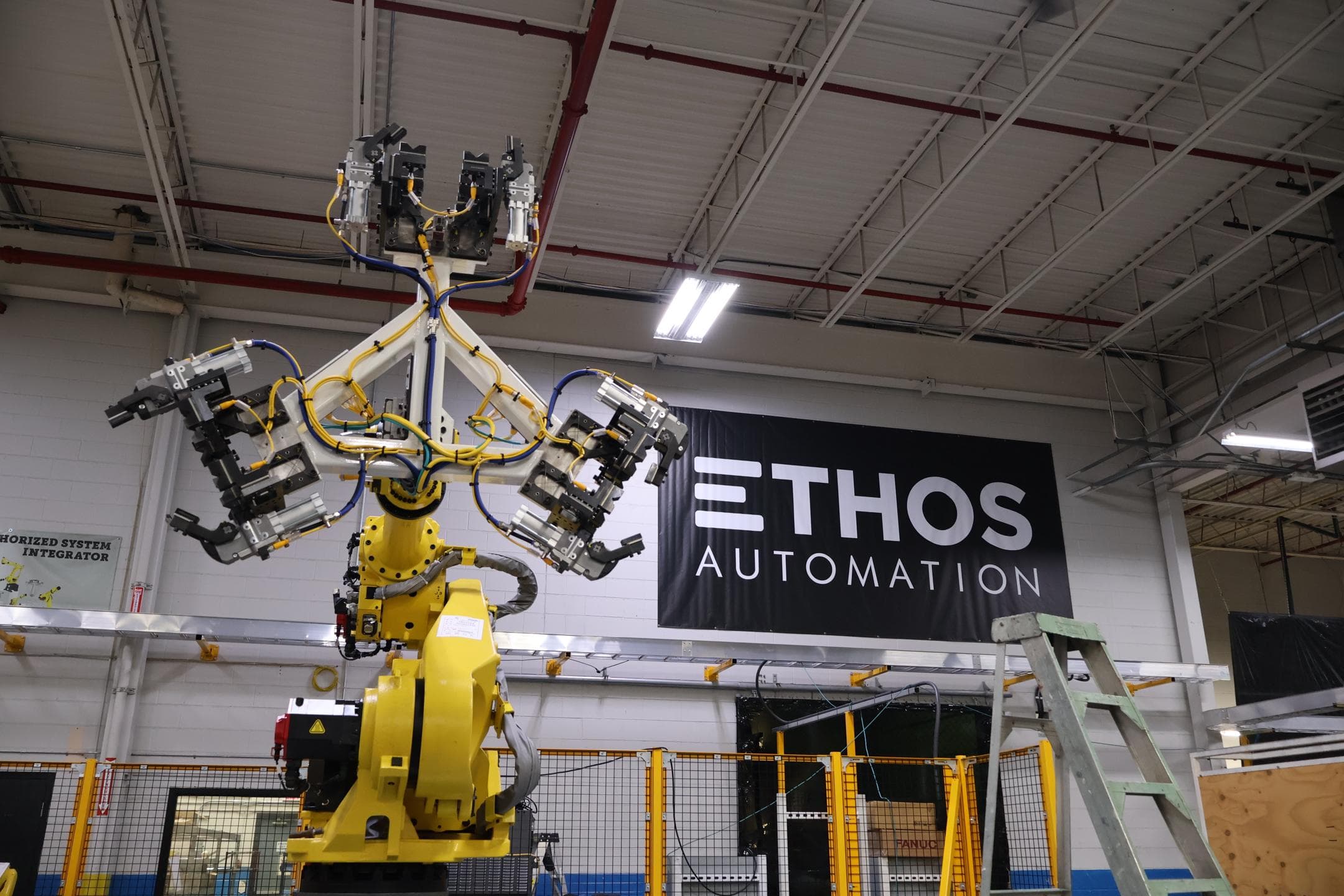
1.42 million assemblies a year, twelve robots, seven components
A Tier 1 automotive supplier was running a liftgate bracket assembly on up to twelve operators loading manual presses, managing left-hand and right-hand variants across two vehicle models.
The brief was to automate the whole process, loading through packaging, and to do it with robots rather than fixed hard automation so the equipment would outlive the vehicle program it was built for.
The system runs twelve FANUC robots. Four handle precision picks from bowl feeders. Five move forgings, stampings, and assembled brackets between stations. Three take the complex work, including a tool-changer robot that packs finished brackets into bins and places the cardboard layers between them.
The hard part was not the robots. It was tolerance stack-up. The assembly involves four components, each with its own tolerance band, and in high volume they regularly arrive at their limits simultaneously. Tooling designed for nominal parts does not work on a stack built from extremes. Absorbing that full envelope of variation while holding cycle time was the central engineering problem.
1.42 million assemblies produced annually, on equipment the customer can redeploy to the next program.