
Consider the last part in the bin.
At the start of a bin, a part is near the top and easy to reach. By the end, an operator is bent over the rim, reaching down toward the bottom of the container with their back past ninety degrees of flexion, several times a minute, for a whole shift. Ergonomists have a word for that posture and it is not a kind one. And it happens at the end of every bin, on every shift, forever.
That was the job at a powertrain manufacturer before this project. An operator standing at each of two CNC machines, picking transmission components out of a bin by hand and loading them into the machine. A third operator loading the laser part marker. Three people whose whole role was moving parts from a container into a machine.
Three problems came with it, and they compounded.
The plant could not reliably staff the positions. Nobody can, at the moment, for work like this.
The posture was doing damage, and the damage was worst at exactly the moment the work was least avoidable.
And the machines could only run as fast as somebody loaded them. The CNC cycle was not the constraint on throughput. The person in front of it was.
The Demo That Always Works
The answer is obviously a robot with a 3D camera. Every integrator has that demo. A robot, a vision system, a tote of parts, and a video where the arm reaches in and comes out holding something.
The demo always works. Production is where it stops working, and it stops working for reasons that have almost nothing to do with the picking.
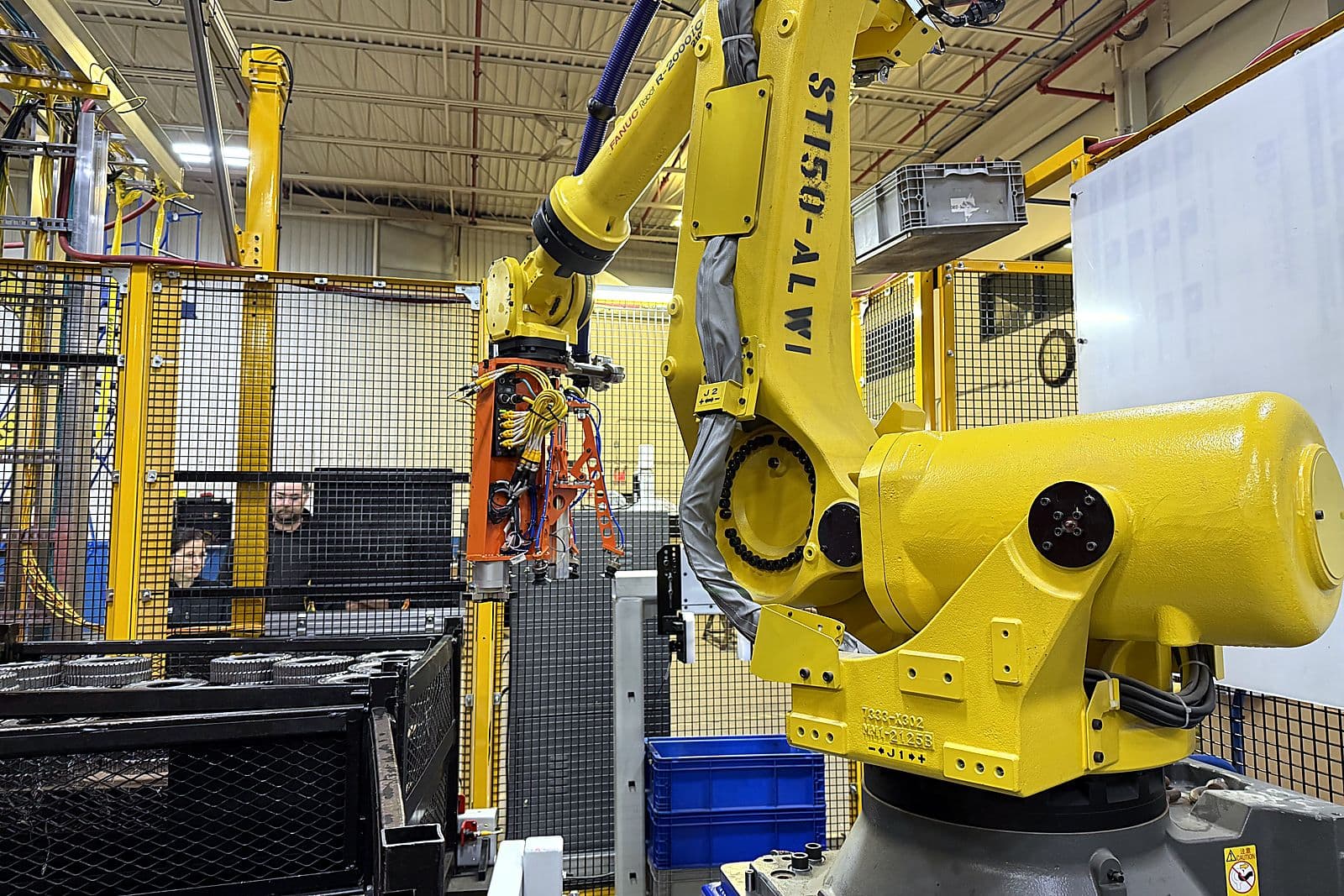
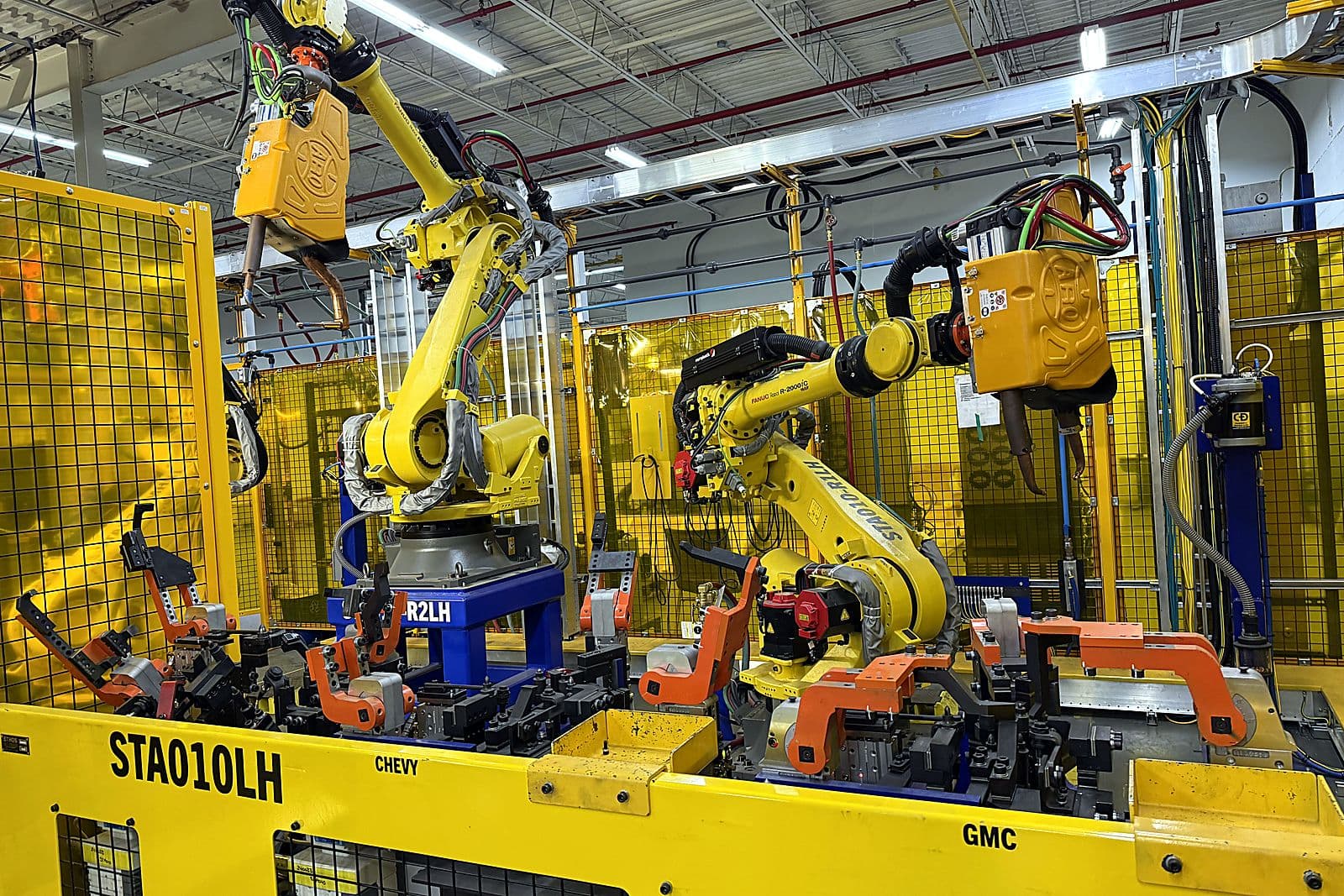
Ethos built this cell with two FANUC robots, three Apera AI 3D vision cameras, and a twenty second cycle to hit. The vision system did the part that looks hard on video. Everything else is where the project lived.
What Actually Goes Wrong
Start with the bin, because the bin is the problem.
A parts bin in a real plant is not a staged demo tote. It arrives with a plastic liner in it, and that liner does not stay politely at the bottom. It slumps, it rides up, and sooner or later it falls across the top of the parts, at which point a camera looking down into the bin sees plastic film rather than steel. Nothing is wrong with the camera, the AI or the robot. The cell simply cannot see.
Parts do not lie flat either. As a bin empties, components end up standing on end against the bin wall at angles nobody designed for, presented to the camera in orientations that were not in the training set and that no gripper approach was planned around.
And between layers of parts there are corrugated plastic pads, which have to come out before the layer beneath can be reached, from positions that change every time.
None of that is a vision problem. All of it is an integration problem, and it is the reason bin picking demos outnumber bin picking installations.
Three Points of Suction
The corrugated pad is worth dwelling on, because the fix is the kind of thing that only comes from doing it.
The obvious approach is to pick the pad up with a vacuum cup. The trouble is that a large sheet of corrugated plastic, lifted at one point, is a lever. Any lift is slightly off centre, the sheet tilts, air breaks the seal at the edge, and the pad drops back into the bin, sometimes on top of the parts the robot was about to pick.
So the tooling holds the cardboard at three separate suction points rather than one. If a single point lets go, the other two still have it, and the sheet comes out instead of falling back in. Three chances at every lift instead of one.
That is the whole fix. It is not sophisticated and it did not come from a specification. It came from watching pads fall back into bins.
Building a Repeatable Look Into the Bin
The vision system locates parts relative to the camera. That only helps if the bin itself is somewhere predictable, every time, which means the real engineering was in the furniture around the pick.
Ethos designed five identical docking stations, three for parts bins and two for corrugated pad removal, deliberately standardised so any one could replace any other. Each locates and locks a customer-supplied production cart against a datum, so the bin presented to the camera sits in the same spatial reference frame on every exchange, regardless of the manufacturing variation in the carts themselves.
That mechanism went through real iteration. The concept work ran through a shepherd's hook dock and a datum cart dock in left and right hand variants before one approach was confirmed. The latch drive shaft was revised to a square profile for better locking engagement. A hold-back cylinder was added to retain the cart against the reaction forces of a robot picking out of it, because a cart that shifts under load has moved the reference frame the vision system depends on. A safety sensor was added to detect bin presence before the cycle starts, so the robot never picks into an empty dock.
The end-of-arm tooling had to do two different jobs: pick a transmission component from an unpredictable orientation without damaging it, and lift the corrugated pads out from between layers. Cup count, spacing and compliance for that combination could not be calculated on paper. It came from building it and trying it.
The tooling was later extended with a longer rail and a laser sensor for part detection and collision avoidance. That rail extension came out of the build honestly enough: the end-of-arm bearings were found running ten millimetres off the end of their rails, and longer rails were released to fix it.
Downstream, the gripper jaws had to guide each part onto a conveyor within an inch and a half of centre for the handoff to work. Another number that came from iteration rather than calculation.
When the AI Genuinely Cannot See
The interesting design decision on this cell is what happens when the vision system fails, because at some point it will.
The system makes three attempts. If all three fail, it raises a stack light and an audible alarm and asks for a person. That is the whole escalation path, and its restraint is the point. A cell that tries to be clever about an obscured camera will eventually do something expensive. A cell that tries three times and then asks for help costs a plant thirty seconds of somebody's attention and keeps the parts and the tooling intact.
Knowing which failures to automate around and which to hand back to a human is not a technology decision. It is a decision about what the cell is for.
The Camera They Did Not Buy
The second robot picks parts off the output conveyor of the second CNC. The obvious solution is a fourth camera.
Instead, Ethos engineered the conveyor's stopping position to be consistent enough that the robot could pick from it blind, with no vision at all. The part arrives in the same place every cycle because the machine was made to put it there, so nothing needs to look at it.
That is the trade every automation engineer should make and few write down: a sensor added to tolerate variability costs money forever, while variability removed at the source costs money once. One fewer camera, one fewer calibration, one fewer thing to fail at three in the morning.
A Cell That Keeps Running With People In It
The hardest controls problem on the job was not the robots. It was that operators still have to be inside the cell's working area constantly, swapping bins, tending the CNCs, doing maintenance, while the robots stay in service.
The standard answer to a safety zone breach is to stop, or to drop everything to a crawl. On this cell either would have been fatal to the business case, because the interruptions are not occasional. They are the normal rhythm of the job.
So the cell was built with a multi-state speed architecture that reads a combination of conditions rather than any single trip. With the roll-up door open, the bin at its safety position and both light curtains clear, the robots run at full speed. With the outer light curtain blocked and the inner one clear, an operator is present but not yet in the dangerous part of the envelope, and the robots continue at twenty five percent. With no bin at the safety position and both light curtains blocked, the combination is unsafe on its face and the cell takes an emergency stop.
Every one of those states was validated with Dual Check Safety stopping distance calculations, proving the robots could decelerate from both full and reduced speed inside the zone boundaries, and the whole scheme was reviewed against pre-start health and safety requirements before it ran.
The result is a cell that lets people work around it instead of stopping every time they approach, and that is the difference between a machine a plant uses and a machine a plant resents.
Four Machines That Were Already There
Ethos supplied the robots, the vision, the tooling, the docking and the safety. The two CNCs, the washer and the laser marker were already on the floor, from different vendors, with their own interfaces and their own ideas about sequencing.
Tying them together over Ethernet/IP, so that two robots, three cameras and four existing machines run as one cell with deterministic sequencing and sane fault handling, is the unglamorous majority of an integration job. The robot-to-vision link runs over a socket messaging protocol on the FANUC controllers, delivering pick coordinates and carrying the retry sequence. Two operator interfaces cover cell status, alarms and manual control.
The Result
The cell is in production. It runs an eighteen second cycle against a twenty second target, and builds 575,280 parts a year across two shifts.
The three load positions are gone. Nobody stands at a CNC lifting parts out of a bin any more, and nobody reaches into the bottom of a container with their back past ninety degrees. The plant no longer has to fill three roles it was struggling to fill, and machine throughput is no longer set by how fast a person can load.
That last point is the one that compounds. A CNC fed by hand runs at the speed of the hand. A CNC fed by a robot runs at the speed of the CNC, every cycle, on both shifts, whether or not the position was filled that morning.
Why This One Matters
Bin picking has been five years away for about fifteen years. What changed is not that the AI got good enough, though it did. It is that the engineering around the AI got understood.
The vision system on this cell does what the brochure says. The reason the cell works in production is the five docking stations that put the bin in the same place every time, the three points of suction that stop a sheet of cardboard falling back into the bin, the retry logic that knows when to stop guessing, the conveyor stop position that removed the need for a fourth camera, and the safety architecture that lets people keep working while the robots run.
Picking is the easy part. It was always going to be.