
Most automation case studies start with a manual process. This one starts with a line that was already automated, had been running for the better part of a decade, and had never once done what it was bought to do.
The customer is a major Tier 1 automotive supplier. The product is a rear twist axle for a battery electric passenger vehicle. The line that built it had been in production for seven to nine years and in that entire time had not hit its quality requirement or its cycle time. Not occasionally missed them. Never hit them.
That is the part worth sitting with, because it is the part most people in manufacturing recognise. Nobody is going to write an article about a line that almost works. It does not fail loudly enough to get scrapped and it does not run well enough to be left alone. It just quietly costs money every shift, for years, while everyone learns to live with it.
The brief to Ethos was to replace it. The constraint was that Ethos would have to build the replacement out of the old one.
Hands Tied Before The First Drawing
The timing explains the constraint. When this program was scoped, the EV market had just fallen out from under everybody. Volumes that had been forecast with confidence eighteen months earlier were suddenly guesses, and no Tier 1 was going to sign off on a floor full of new robots for a product whose demand nobody could forecast.
So the direction was reuse. Not reuse where convenient — reuse as the default, with every exception needing justification. Ethos began design with its hands tied on what it could and could not specify.
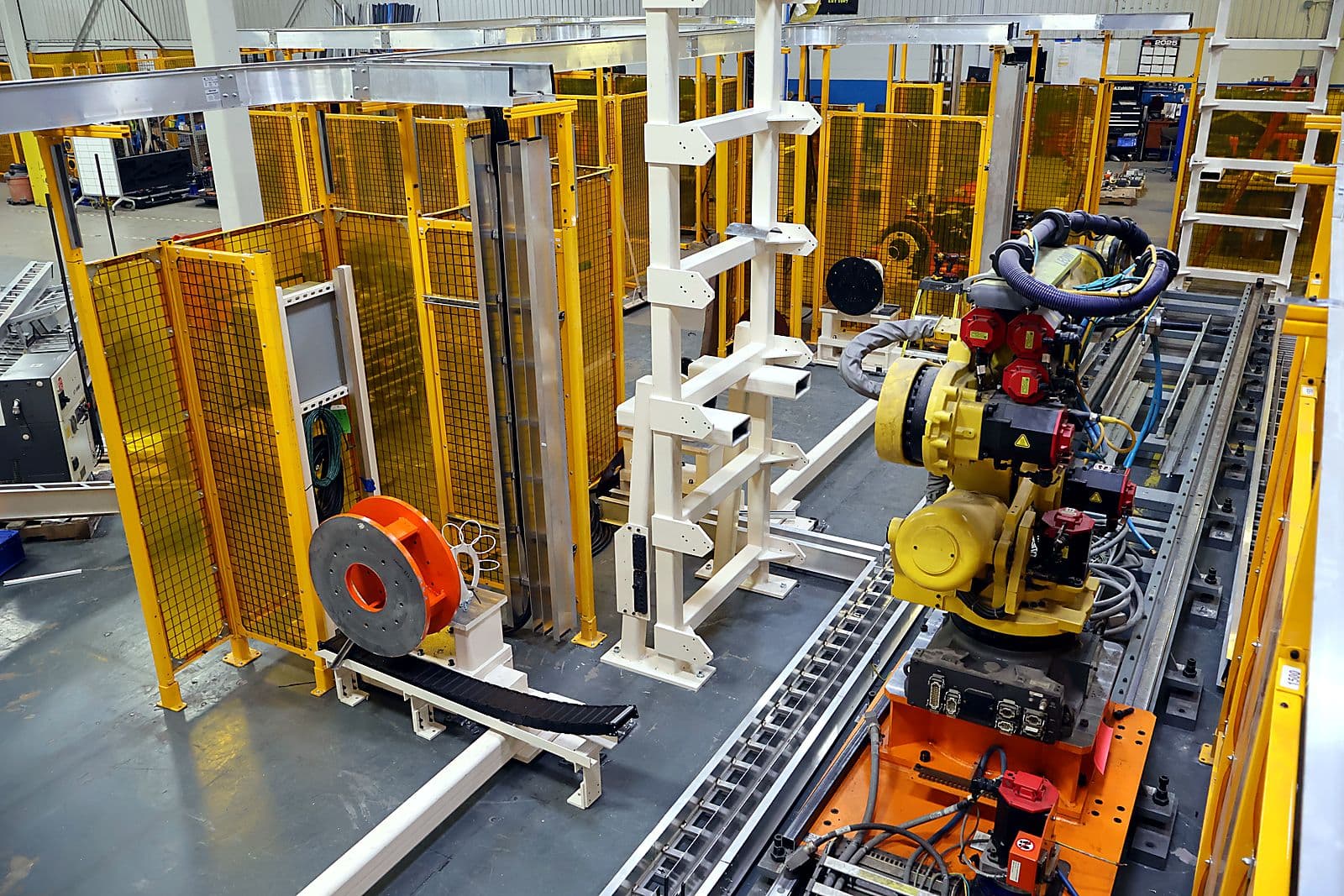
What came back from the teardown of the old line, credited against the project as free-issued equipment, gives a sense of the scale: fifty-two Balluff I/O blocks, master and slave. Thirty-five Destaco power clamps. Eighteen Welker shot pins. Fifty-eight NSK linear bearings and fifty feet of rail. Six laser distance sensors. Two barcode readers and two smart cameras. Forty-six pre-assembled network cables. Fourteen complete station valve bank assemblies. Trunnion headstocks and tailstocks. Fencing, roll-up doors, control panels, HMIs. Eight MIG welding robots and four material handling robots, including two front-end weld robots that came off the customer's production floor with their old programs still on them.
The condition was mixed and it did not correlate with anything useful. The fencing was fine. The I/O blocks, the trunnion assemblies and the stack lights were old and worn. Nothing about the state of a component could be established by looking at it, which meant every assumption in the design carried a risk that could only be retired by putting the part on the bench.
That is the honest technical description of this project: not a robot integration, but a very large exercise in engineering against unknowns you inherited.
The Induction Heater Nobody Understood
The single hardest item was an Ambrell induction heating system.
Its job is not obvious unless you know the process. The axle tube is heat treated, and heat treatment changes the grain structure of the steel in a way that stops a weld bonding properly. So before the tube ends are welded, they have to be brought back up to temperature by induction. Get that wrong and the weld looks fine and is not.
Four things were true about this system when it arrived at Ethos.
It was completely torn apart. The customer's tear-out crew had disassembled it and the components arrived disorganised. There was no record of what condition it had been in before they started.
There was essentially no documentation. A manual with some basic wiring diagrams existed at the time of integration and has since been lost. No maintenance records. No specifications.
Ethos had never worked with an Ambrell system before. No internal knowledge base, no prior project to draw on.
And nobody on the customer's engineering or maintenance side knew anything about it either. No contact was made with the manufacturer. There was no one to ask.
Two Ethos electrical engineers reverse-engineered the whole system from their own analysis — inventoried the parts, worked out the wiring, reassembled it, plumbed the cooling water and leak-tested it before anyone was allowed to energise several kilowatts of induction equipment, and brought it back to the temperature and dwell parameters the old process had specified. Those parameters were the one thing that did exist on paper; everything required to reliably achieve them again had to be rebuilt from nothing.
The Coils That Were Never Drawn
There is a footnote to the induction system that is really a story about how manufacturing knowledge actually gets stored.
The coils that pre-heat the part are not catalogue items. Over the eight years the program had been running, they had been manufactured and custom bent by hand to follow the profile of the part — at exactly the right standoff to get heat penetration where it was needed, and shaped to leave the torch access to do its job. Every one of those bends encodes a decision somebody made on the floor.
None of it was ever revised back into CAD.
So when Ethos needed the coils re-manufactured, the drawings on file described a coil that no longer existed anywhere, and the physical coils in storage described a shape nobody had ever recorded. The supplier's CAD, when it arrived, turned out to be for the original coil rather than the one in service. The only way forward was to have the real coils 3D scanned and use the scan as the model to modify from.
Eight years of hand-tuned process knowledge, held entirely in the bent geometry of a piece of copper, recovered with a scanner because it had never been written down anywhere else.
High Current, Rotating Fixtures, and Everything Trying to Interfere With Everything Else
The welding on this line uses coordinated motion. The trunnion rotates the part while the robot welds it, so that the weld running around each end of the tube is laid down as one continuous bead — no stopping the trunnion, no breaking the robot's weld path, no restart. Restarts are where weld defects live, and on a part where the welds are structural, removing them is a quality decision as much as a cycle time one.
The robots the customer supplied did not have the coordinated motion option on them. That upgrade had to be arranged on Ethos's floor mid-build, and it was not the only option missing — the same robots were later found to be without their Dual Check Safety package, discovered about a week before the cell was due to dry cycle.
Underneath the motion sat a harder problem: routing.
Cables and pneumatics have to get into a fixture that rotates through more than 270 degrees, and the induction heating lines running through that envelope carry enough current to interfere with the weld ground cables and the ethernet running alongside them. The mechanical design team's answer was to give the induction lines their own isolated cable tracks, a dedicated continuous run into the tool, which solved the interference and had the second benefit of stopping the coil lines kinking as the trunnion turned. Cable tray drums were added at the first weld trunnion to manage the rotation, and two of the three trunnion station frames went through a full structural redesign, at two separate revision levels, once the part geometry was checked against them properly.
Then there was the power delivery constraint, which is the kind of problem that only shows up on a reuse job. The main supply lines from the control panels to the induction head units were customer-ordered, long-lead cables, and they were being reused. Their length mattered: run them any longer than necessary and resistive loss in the cable means the head unit does not get the power it needs. So the panels were repositioned, the runs were measured and minimised, and the wiring of the reused cables was reverse-engineered to reconnect them.
None of that is in a scope of work. All of it has to happen before a single good part comes off the line.
Ninety-Four Versions
The control system is where the whole thing either becomes a line or stays a collection of stations.
Ethos built it as a dual-zone PLC architecture, two main control panels splitting a cell of more than fourteen stations, carrying a genuinely unusual mix of sensing for a welding line: 2D smart cameras, 3D profile inspection, 2D barcode readers for part tracking, precision LVDT gauging, floor scanners tied into the safety architecture, and the induction system's own signals. All of it had to sequence inside cycle time, and the safety logic had to be right the first time.
The record of how that went is in the version history. The primary PLC program went from V002 at the start of the project to V096 at final commissioning — roughly ninety-four discrete development versions, with the safety program running its own thirty-nine in parallel. The HMI was built across five separate zone files.
The precision gauging is worth pulling out, because it is the clearest example of why the quality requirement on this line was not negotiable. After machining, LVDT sensors measure the machined surface of the bearing plates. That surface sets the toe and camber of the vehicle's rear wheels. If it is out, the car does not track straight. There is no downstream inspection that catches it and no way to adjust it later. The gauge is the last honest look anyone gets.
Adding an Inspection System Mid-Build
Partway through, the customer's upper management made a call: they wanted certainty on weld quality, not confidence. That became a new inspection station built around a SmartRay 3D profile scanner, added to the project as an engineering change worth $172,824 and carried on two dedicated inspection robots.
SmartRay uses structured-light laser triangulation to build a 3D profile of the weld zone. It is a fundamentally different sensing method from the 2D smart cameras already in the cell, and it was Ethos's first project with the technology.
The integration problem was timing. Scanning takes time, and a station that stops the line while a sensor thinks about it is a station that eats the cycle. The data acquisition had to run asynchronously, in the background, while the robot was still moving — and neither FANUC's documentation nor SmartRay's covered how to do that. SmartRay's own application engineer confirmed that a custom background program on the robot was the only route. Ethos wrote and commissioned it, built the station, the robot mounting geometry, the guarding and the cell modifications to fit it in, and developed the integration framework and robot paths before a SmartRay-supplied engineer took the application programming the last mile.
The engineering change went through four revisions over nine months as the customer refined what they wanted. The station was installed on site in February 2026, roughly eight months after the main line went into production — a second project bolted onto the end of the first.
It is worth being clear about what that scope addition means commercially. A customer who hands their integrator another $173,000 of work mid-project, for a quality system, is a customer who has decided the integrator is going to get it right.
Eight Weeks
Six weeks after kickoff, the customer compressed the timeline by eight weeks.
That is the fact that makes everything above harder, because schedule compression does not reduce the work, it removes the slack that absorbs other people's delays. And on a project where most of the hardware belonged to the customer, other people's delays were the main risk on the board.
The robots slipped by roughly a month against their first promised delivery. The cable tray had a lead time long enough that the team built the entire cell with the wrong size, knowing it would be pulled out and replaced at final install, rather than wait. Fence stanchions arrived too short. Some fence panels arrived bent. The hydraulic power unit for the pierce station arrived and did not work — reused from another line, fitted with a new panel, missing the main communications cable between old panel and new, and with every sensor cable cut. There was no updated electrical drawing. Ethos rewired it and reverse-engineered the connections.
There were smaller versions of the same story throughout. A gripper that had to have side wipers added because the part's holes sat offset from the pick point, so lifting it made it tip and bind on the locating pins and fault the robot — on the one end-of-arm tool at the front of the cell that had to clear the tooling in all three weld trunnions, the buffer racks, the pierce tool and the machining centre. A water chiller the customer decided mid-build to eliminate, plumbed out to plant supply, then partially reinstated when maintenance asked for the filter back and wanted the option of adding the chiller later.
Ten formal deviations from the customer's build standard were raised and approved across the project, covering things like backing the weld gun off from the standard 16 mm stickout to 20 mm to clear a nut on a bracket, and specifying non-standard actuators where the standard ones physically would not fit.
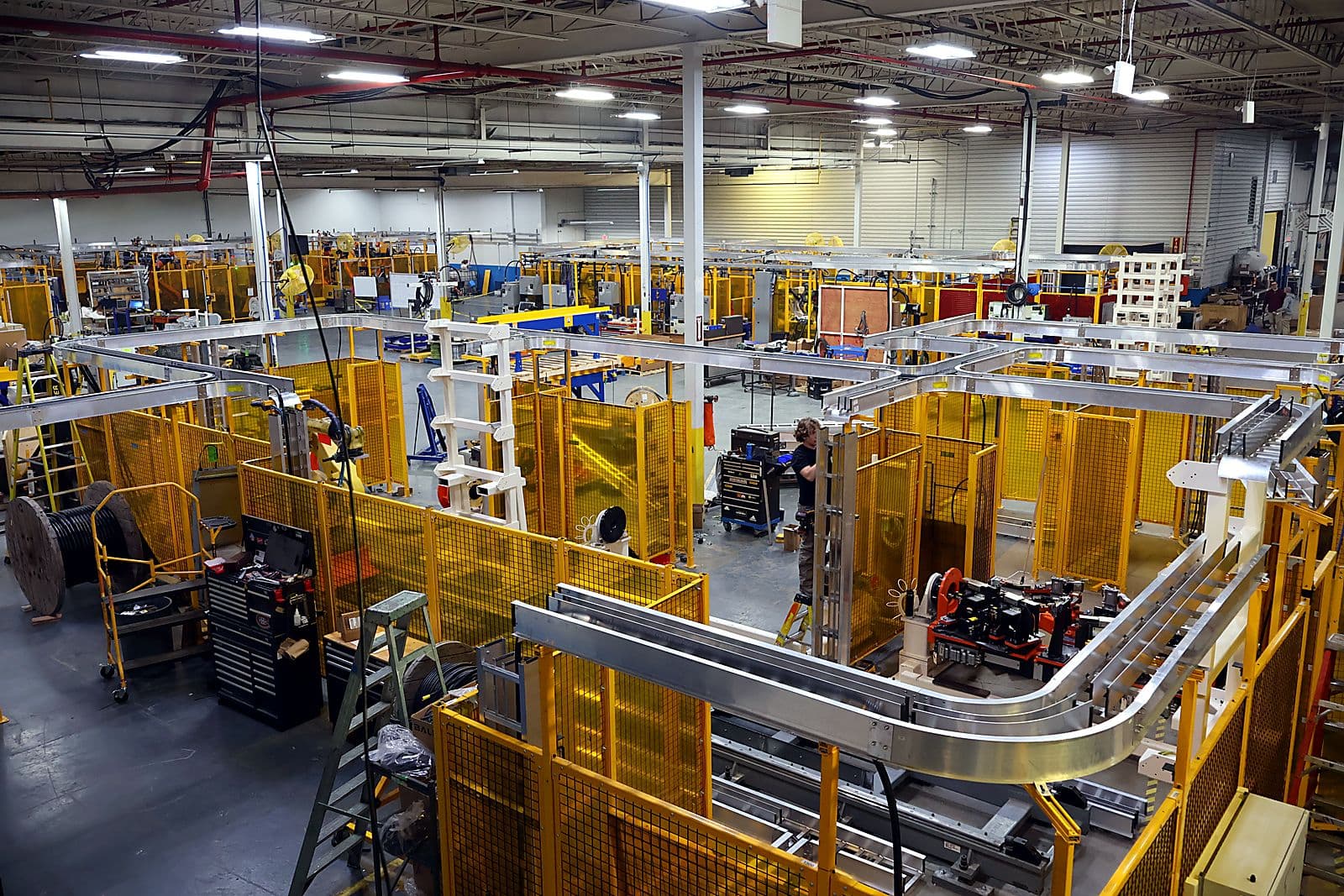
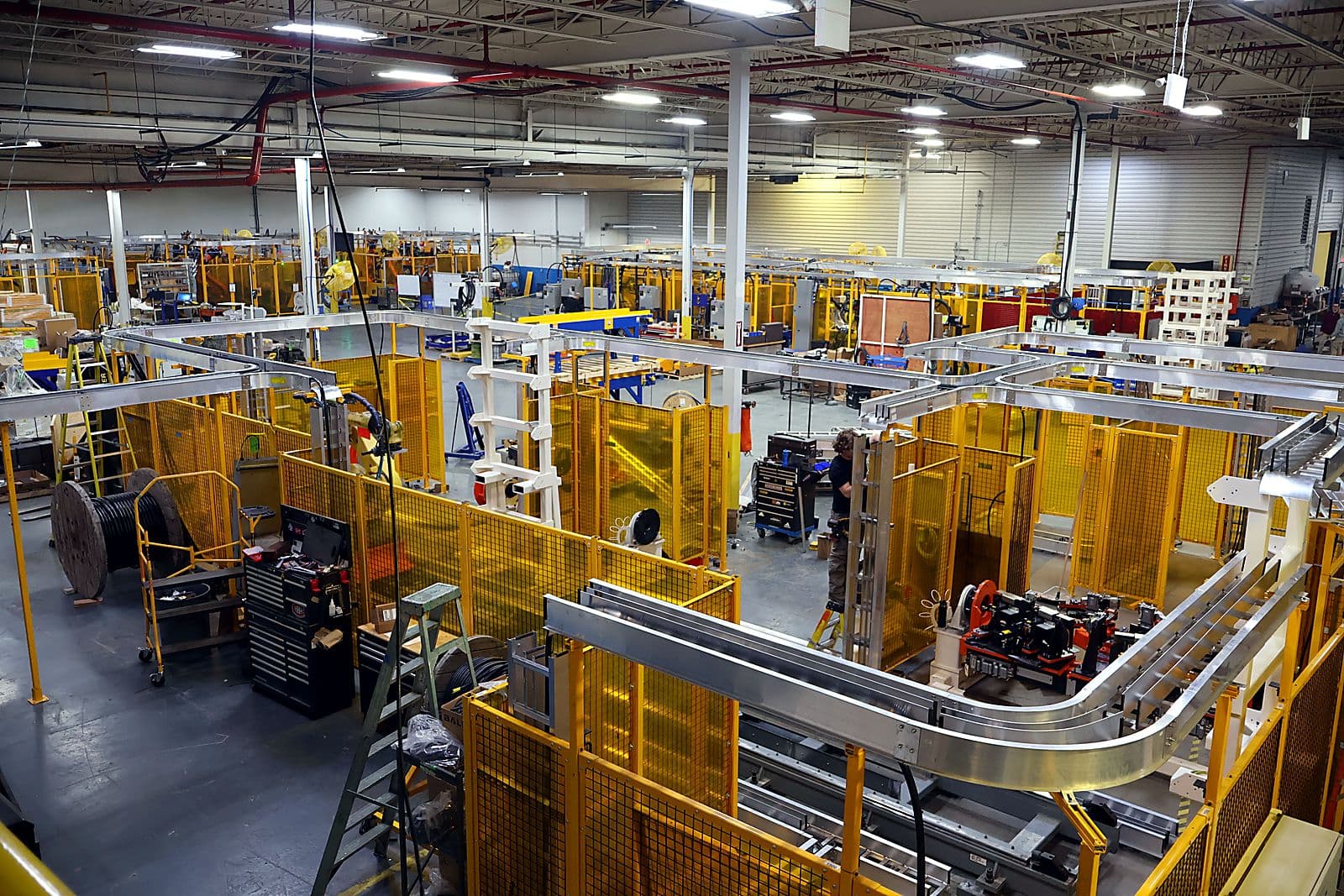
The line was built, integrated, powered up and run at rate on Ethos's floor. Teardown started in April 2025 and installation at the customer's plant was complete in June. Robot programming had started on Ethos's floor in March; on-site programming could not start until June, when the plant had power to the cell, and ran through July.
The Result
The install landed on time. The project landed on time overall — including the eight weeks the customer had taken out of it partway through.
Run at rate happened. The line was designed to a base cycle time of 164.3 seconds per set. It runs at 158.3 seconds average. It is in production now, capable of more than the 56,350 units a year it was contracted for, and building to whatever its customer actually orders.
Quality is the number that matters most here, given the history. The line scores above 95 percent on PIST, close to a perfect score.
Headcount did not change. That was never the point. The point was a line that hit its numbers, after nine years of one that did not.
What The Customer Said
The most telling response was not written down anywhere. It was said out loud, and it was that Ethos had changed their mind about twist axles.
Twist axles have a reputation in this industry, and the reputation is that they are miserable. Long, welded, structural, and dimensionally unforgiving, with quality that drifts across the life of a program and a constant low-level tax of chasing parts back into spec. Enough Tier 1 suppliers have been burned that a good number simply will not quote them.
The line Ethos delivered produces a part that is in spec without being fought into it, and stays in spec without being chased. That is a different proposition from a line that merely works, and it is the reason a customer changes their mind about a whole product category.
Which is the real answer to what this project was about. Not twelve robots. Not the induction heater or the 3D scanner, satisfying as those were. A part that comes out right, on a line assembled largely from the same equipment that had been failing to make it right for the better part of a decade.