
The hardest processes to automate are not the complicated ones. They are the ones nobody ever wrote down.
At a Tier 1 automotive seating supplier, two assembly lines build the side frames that form the structure of a car seat, across a range of models for a range of vehicles. Everything upstream was automated and specified. The end of the line was not.
There, a forklift placed an empty bin onto a stand. An operator took each finished frame off a chute, turned it, and placed it into the bin. When a layer was full, they laid a sheet of cardboard over it and started the next one. Part after part, layer after layer, until the bin was full and the forklift took it away.
Nothing about that process was written down in a way a machine could follow. The parts were placed and nested however the operator saw fit.
That sentence is the whole problem. It is not a criticism of the operators, who were doing something genuinely skilled. A person looking into a half-full bin can see where a frame will sit, judge whether it will nest against its neighbour, notice that this model is a little different from the last one, and adjust. They do it without articulating any of it. Ask them to write the rule down and they cannot, because there is no rule. There is judgment.
A robot has no judgment. Everything the operator was deciding in the moment has to be decided in advance, for every model, every layer and every position in the bin, and then it has to be right every time.
Retrofit, Not Replacement
Two things shaped the job before any design work started.
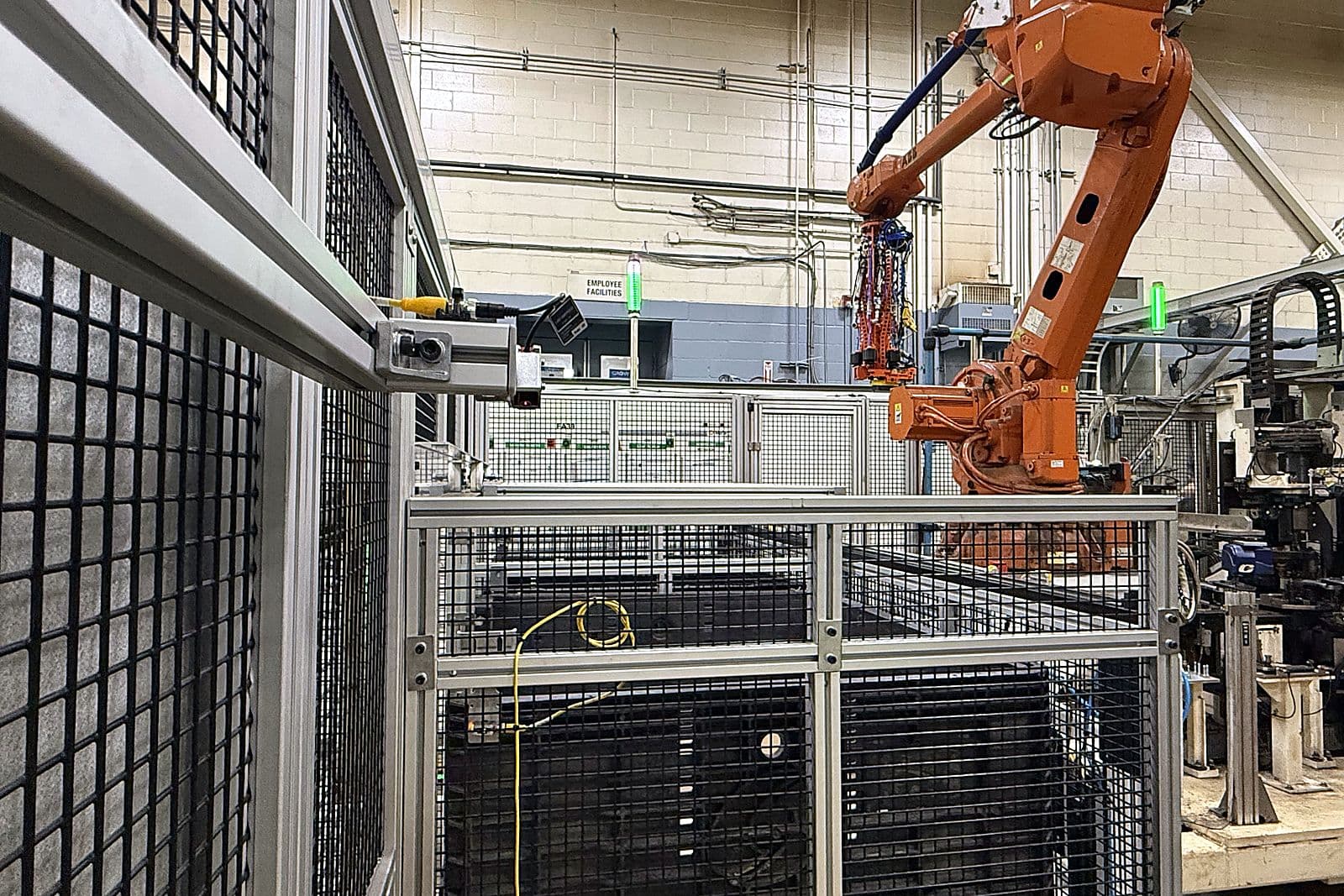
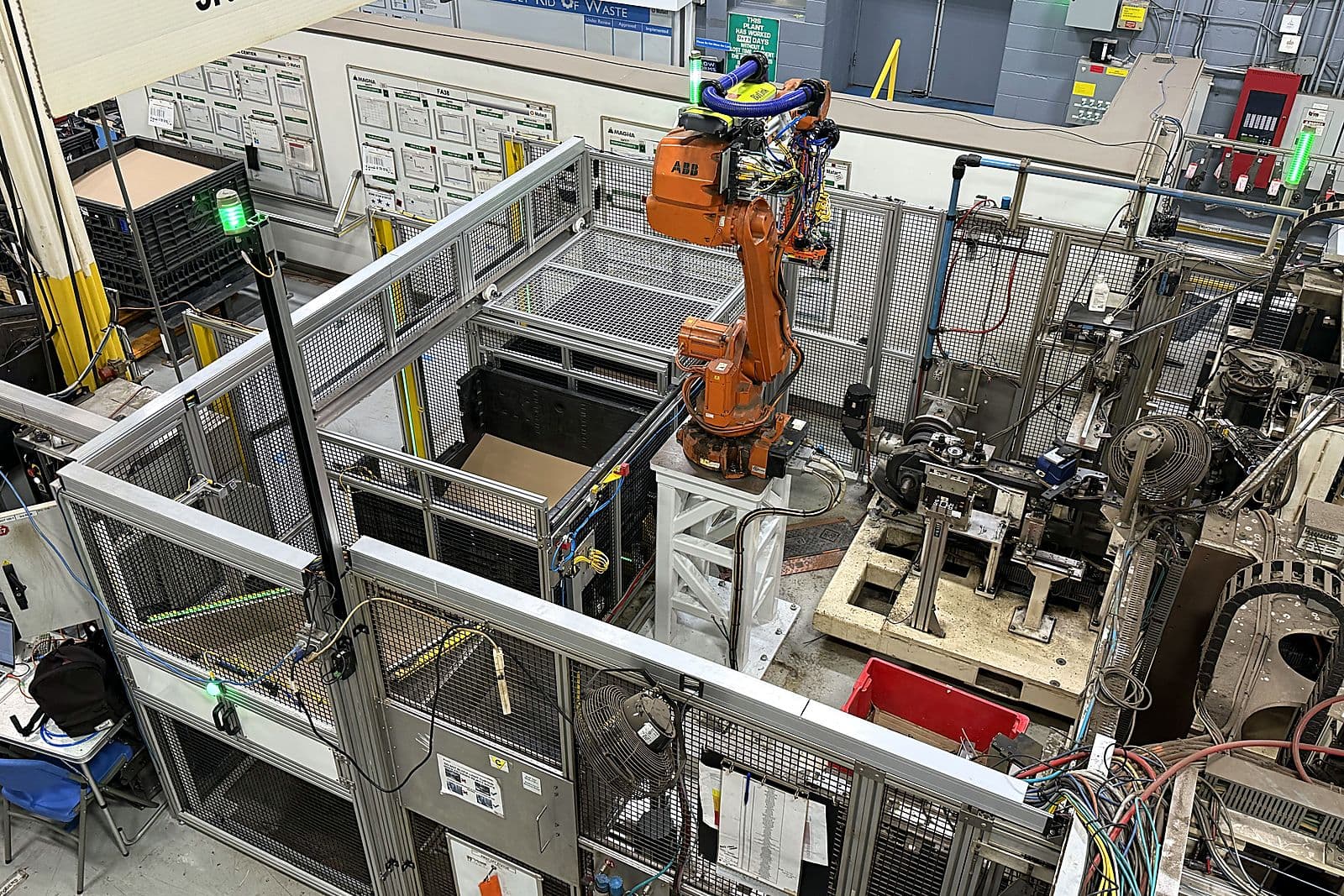
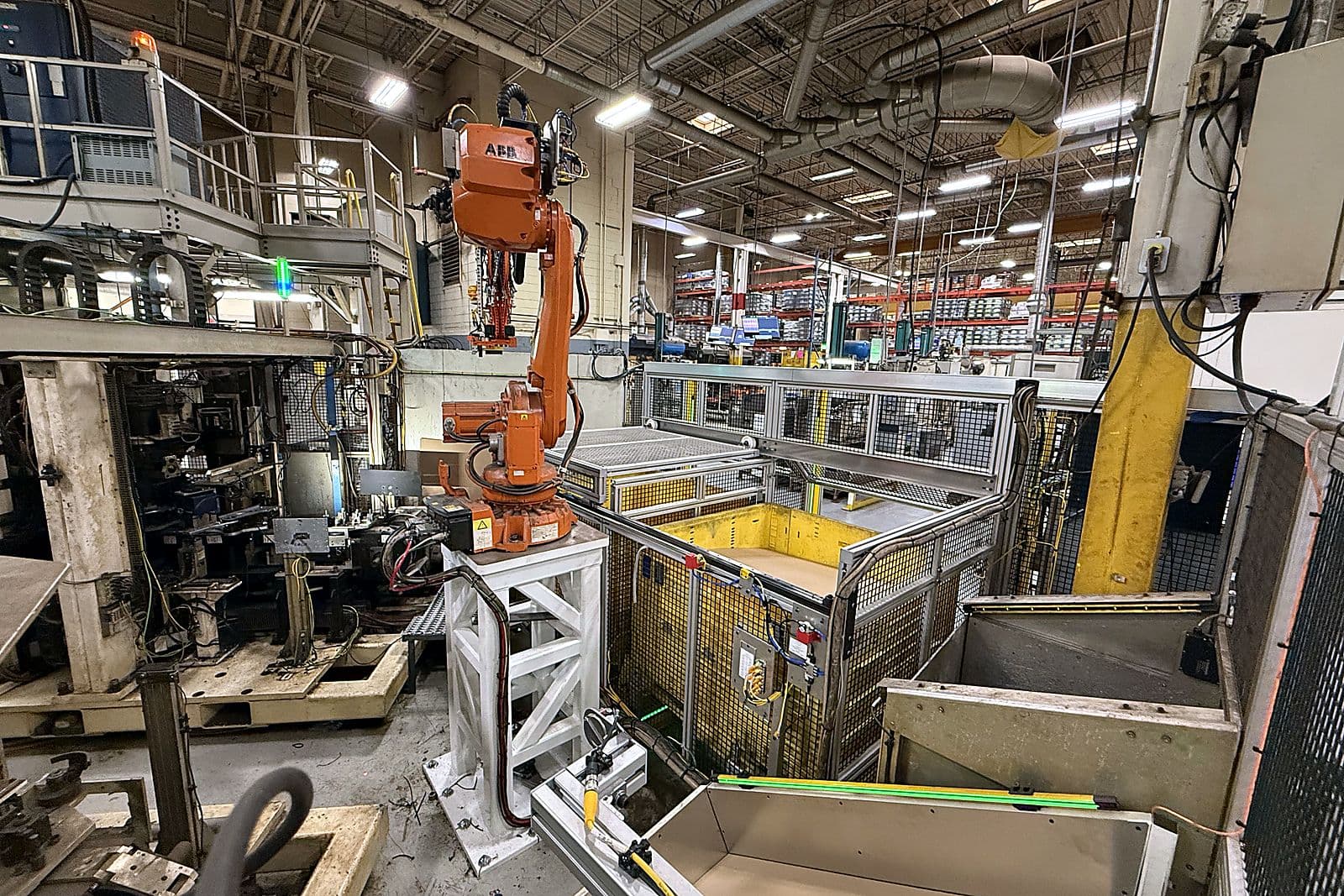
The first is that this was a retrofit of two lines already in production. The robots were already there, the customer's own ABB machines, and the brief was to reuse them rather than buy new. The same went for the valve banks and much of the surrounding infrastructure. Everything designed had to fit into cells that already existed, around equipment already bolted down, on lines that still had to make parts.
The second is that there were two of them. Two lines, each needing the same kind of end-of-line, each needing the existing line stopped while the work was done.
The Decision to Go Slower
In April the team assessed installing both retrofits inside the same window and concluded it was too risky.
That is worth sitting with, because the commercial pressure runs entirely the other way. One mobilisation instead of two, one set of paperwork, one disruption to the plant, and the customer gets both lines back sooner. Everything about doing them together looks better until something goes wrong on one line while the other is also in pieces.
So one line went first, on its own, and the second followed afterwards. The second install carried every modification learned on the first, which is the real payoff: by the time the team reached the second cell, the changes that only reveal themselves during a live install had already been found and fixed on the first.
Going second is much easier than going first. The only way to get that benefit is to refuse to do them at the same time.
Teaching a Robot to See Cardboard
The cardboard turned out to be one of the more interesting problems.
Interleaving sheets between layers is trivial for a person. For a vision system it is awkward: cardboard is a flat, low-contrast, non-reflective sheet lying on top of other flat things, in a bin, in changing light. A camera looking down at a stack of it has a hard time telling how many sheets are left, or where the top one begins.
The team considered using the vision system to find each sheet and rejected it, in favour of establishing a datum on the stack once and working from there. A known reference point and a count is more reliable than asking a camera to solve a problem it is poorly suited to, and it is faster.
That kind of decision recurs through the project. The question is rarely whether something can be sensed. It is whether sensing it is the cheapest, most robust way to know it.
Gripping Frames Full of Holes
Seat side frames are stamped steel, and across the model range they carry a lot of holes in a lot of different places.
That matters for two reasons. A vacuum gripper needs a sealed surface, and holes are where seals fail. And whatever grips the part also has to confirm it actually has the part, which is harder when the surface under the sensor might be a hole on one model and solid metal on the next.
The chosen approach used electromagnetic gripping rather than pneumatic, tested against the largest frame in the range first, on the principle that if it handles the worst case the rest follow. Electromagnetic also gives cleaner part-present feedback than vacuum across a family of parts where the sealing surface keeps moving.
Suction still features in the cell, and the open issues list records something worth repeating: check the suction cup lines for collapse. Automation fails in unglamorous ways, and a partially collapsed hose is the kind of fault that produces intermittent, maddening behaviour weeks after everyone has signed off.
Safety Around a Bin That Has to Be Reachable
A packout cell has an awkward safety geometry. The bins have to be accessible, because a forklift brings them in and takes them away, and the robot has to reach into the same space to load them.
The solution combined interlocked switches with muted light curtains, so that the robot can cross the curtain as part of its normal cycle without triggering a stop, while an actual intrusion still does. Getting that right is not a matter of picking parts from a catalogue: the first switch part number offered did not have the features the design needed, and the alternative had a lead time that threatened the install date, so the team went looking again rather than accept either the wrong part or the delay.
The robots also needed motion supervision software, which one line already had and the other did not, and that had to be resolved on the customer's controllers rather than by swapping hardware.
Marking, Handling, and the Rest of the Line
The scope grew beyond the packout itself, as end-of-line scopes tend to.
Laser part marking was brought into the cell, with each model marked in its own location and left and right hand variants handled separately. That meant removing existing equipment, tying into the plant's overhead extraction, installing the marker, wiring it, checking the I/O and validating it, and later working through whether modifications to the shroud affected its certification.
Automated mobile robots move bins to and from the cell, which required their own brackets, reflector positioning and integration.
And one part of the scope came directly from watching the first line run. On several models the frame's shaft protruded through the bottom of the bin, which is a problem for stacking and handling. The answer was a flip station at the end of line, so the part is turned and the shaft points up instead. It was designed, quoted, built, commissioned and installed.
The Result
Both lines are installed, commissioned and running.
Each cell handles every model in the range. The first runs at 10.8 seconds a part, the second at 11.2.
That is the number that matters, because an end of line cannot be the constraint on a line that is already fast upstream. It is also a number that only exists because somebody had to decide, in advance and for every model, exactly where each frame goes and in what order. The speed is a consequence of the specification, not a separate achievement.
More significantly, the bin that comes off the end is now packed the same way every time. Every frame in the same position, every layer the same, every cardboard sheet where it should be. Not because the rule was finally written down, but because automating the process is what forced someone to work out what the rule actually was.
The operators who used to pack those bins were doing skilled work under time pressure, nesting parts by eye, shift after shift. That job is gone, and what replaced it produces a more consistent bin than judgment ever could, at a rate judgment could not sustain.
What It Says About Retrofits
There is a version of automation that only works on a clean sheet: new line, new robots, specified process, known variation. Most manufacturing does not look like that. Most manufacturing looks like this one, with lines already running, equipment already bought, a process that works but was never specified, and no appetite for stopping production while somebody figures it out.
Getting automation into that is a different discipline from designing it from scratch. It means reusing the robots that are there. Fitting inside a cell that already exists. Finding out what the process actually is by watching people do it, because the documentation describes the intent and the operators are the only record of the practice.
And sometimes it means doing one line at a time when doing both at once would look faster.