
A finished part leaves this cell every nine seconds. In those nine seconds it has been fully welded, inspected for weld defects automatically, laser marked with its own identifier and packed into the right bin.
No station in the cell runs at nine seconds. Nothing in it moves that fast. The number comes from somewhere else, and where it comes from is the whole story.
The customer is a Tier 1 metal-forming supplier. The part is a welded tube with a gear sprocket on it, the sort of assembly that ends up inside a vehicle seat and that nobody ever sees. It is made in six variants — four left-hand, two right-hand — and the plant needed all six coming off one line, in volume, across three shifts, at a required cycle time of fifty-five seconds.
The usual answer is to build a cell, run one variant, change the tooling over, run the next. Changeover is dead time and dead time is the whole argument. The customer did not want changeover at all. They wanted every variant live simultaneously, welded, inspected, marked and packed into its own bin.
And they wanted it built largely out of a cell they already owned.
Starting With Somebody Else's Machine
An existing welding cell was decommissioned at the plant and delivered to Ethos on a truck.
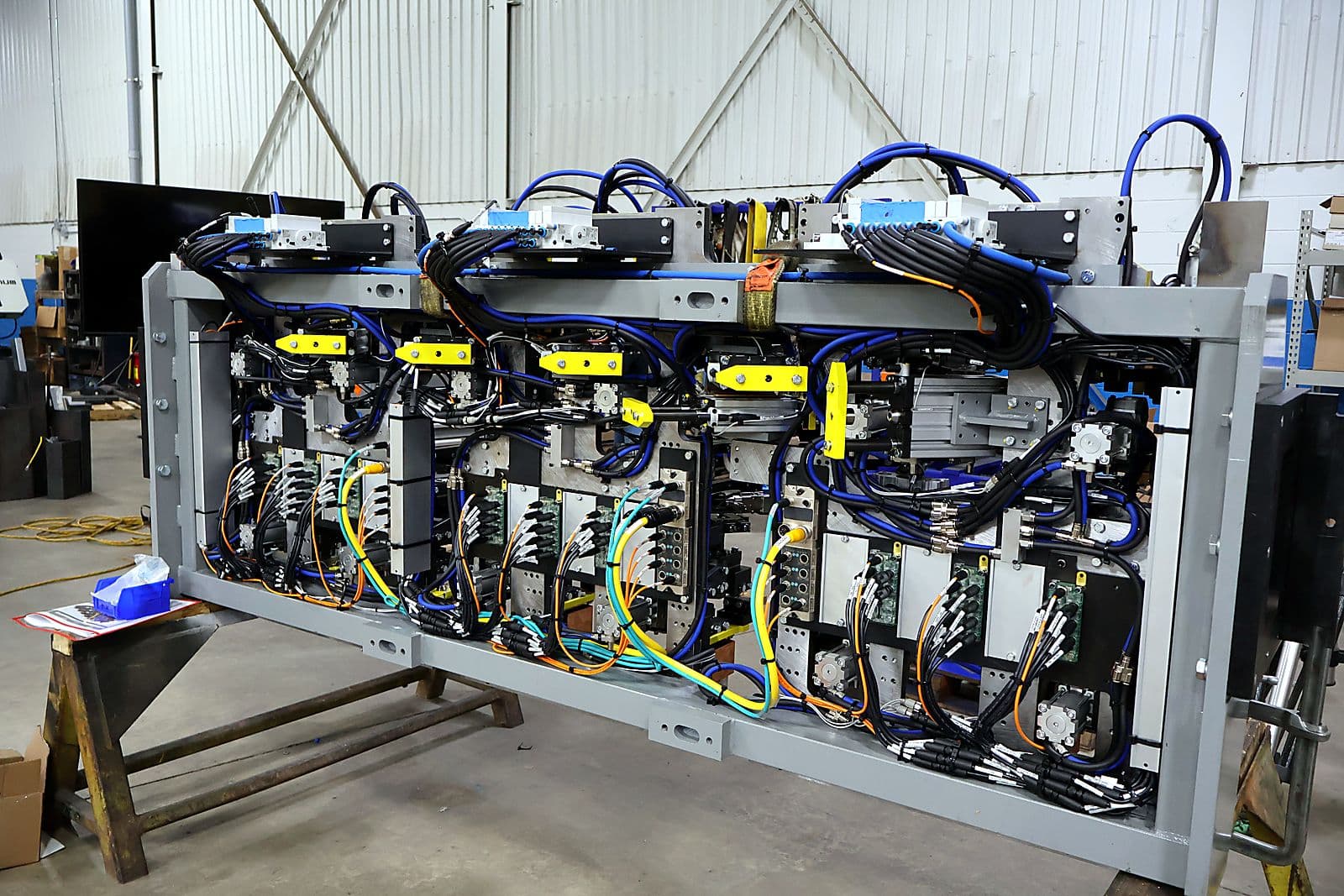
That is a very different starting point from a blank floor. The structure and frame came across. So did the turntable and its trunnions, the robots and their controllers, and the roll-up doors. All of it had been designed years earlier for a different part, by somebody else, to solve a problem that was not this one.
Reuse is usually sold as a saving, and it is one. What gets said less often is that it is also a constraint, and a rigid one. A new cell is designed around the process. A reused cell means the process has to be designed around whatever the steel already does. The turntable turns on the axis it turns on. The frame is the size the frame is. The reach envelope is fixed before a single new part is drawn.
So the engineering problem was not "how would we build this" but "what can we make this do", which is a narrower and more interesting question.
Six in the Fixture, No Changeover
The front of the cell is where the ambition sits.
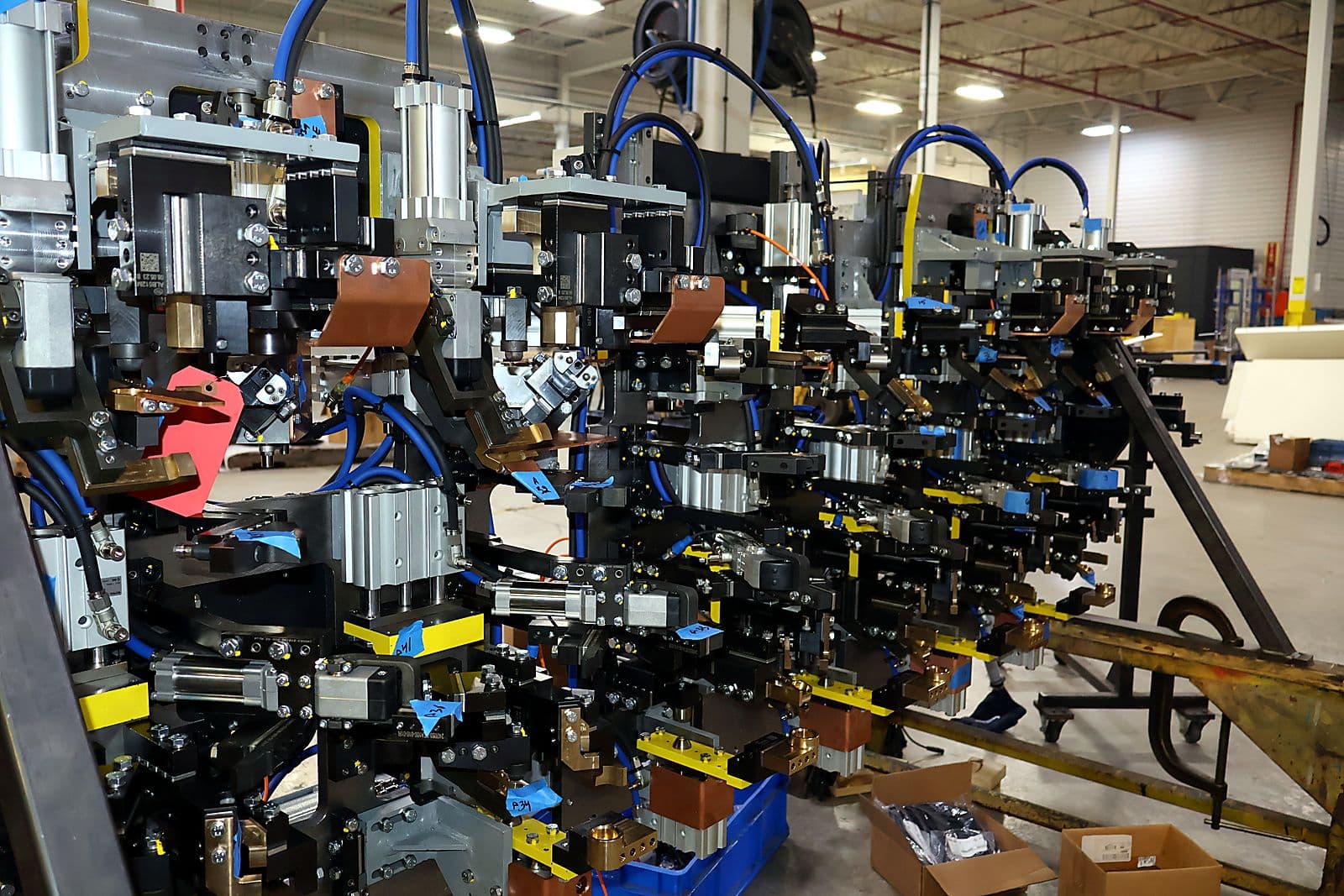
The welding station is a trunnion turntable with an identical A side and B side. Operators load six parts into a fixture — three nests per fixture — and the parts clamp pneumatically. The table rotates the loaded side into the enclosure and the robots begin welding while the operators load the other side. Twelve weld beads per assembly.
The part that makes it work is the tooling. One left-hand fixture has to locate and clamp every left-hand variant correctly, and one right-hand fixture has to do the same for every right-hand variant, with no changeover between them and no operator decision about which is which. The cell has to sense what it has been given and behave accordingly.
That is a tooling problem before it is an automation problem, and it is where the project spent its design effort. Locating features that suit several parts at once. Sensors that tell variants apart when the difference between two of them is a step a millimetre and a half deep. Error-proofing that catches a part loaded backwards, using a pin arrangement that only accepts one orientation and a proximity sensor set a millimetre below the surface to catch a part that has been flipped.
There is also a component inside the assembly that has to be confirmed present before anything is welded: a bushing, two layers thick, a quarter of a millimetre in total, with a low-friction coating that cannot be touched or marked. Nothing contact-based could check it. Nothing magnetic could see through that little material. It took cameras, careful lighting and a long stretch of parameter work to reliably pick a quarter-millimetre edge out of the tooling sitting behind it.
None of that is visible in a photograph of the cell. All of it is the difference between six variants running together and six variants running one at a time.
Then Everything Moves Together
Once the welding is done, the cell stops handling parts one at a time altogether.
A material handling robot with a dual end effector takes all six finished assemblies off the welding station in one motion. The tool holds twelve parts — six coming out, six going in — so that unloading the welder and loading the next station are the same movement rather than two trips. The robot never travels empty.
All six go into the inspection station together, held vertically so the cameras can reach every bead from every angle. Two robots carry the cameras and work across the set, checking the welds on all six assemblies for defects.
From there, all six move into the laser marking enclosure on a shuttle. The marker itself rides on a servo axis and travels to each of the six positions in turn, burning the identifier into each part. Marking six components one at a time would have been the obvious approach and it does not fit in the cycle; moving the marker rather than the parts is what made it fit.
Then a second handling robot, with an end effector that carries all six at once, lifts the marked assemblies out and places each one into its correct finished-goods bin. Four rack stands, each holding a four-foot bin, each watched by a sensor that knows whether it is empty or full. Six different part numbers, six correct destinations, no operator sorting anything afterwards.
Weld, unload, inspect, mark, pack. Six components, every station, every cycle, fifty-five seconds.
Which is where the nine seconds comes from. Divide a fifty-five second cycle by the six finished parts that come out of it and the cell is delivering a completed assembly every nine seconds — welded, inspected, marked and packed. Not one station running at nine seconds. Six parts sharing one cycle, all the way through.
The Part That Is Easy to Underestimate
Running six variants at once sounds like a throughput story. It is really a traceability story.
Every one of those six parts has its own identifier burned into it, its own inspection result, and its own bin. The cell has to know, at every moment, which of the six things in its gripper is which — through welding, through a robot transfer, through an inspection station, through a laser marker on a moving axis, and into the right container at the end. Lose track of one and you have not made a scrap part, you have made a mislabelled good part, which is worse, because it leaves the building.
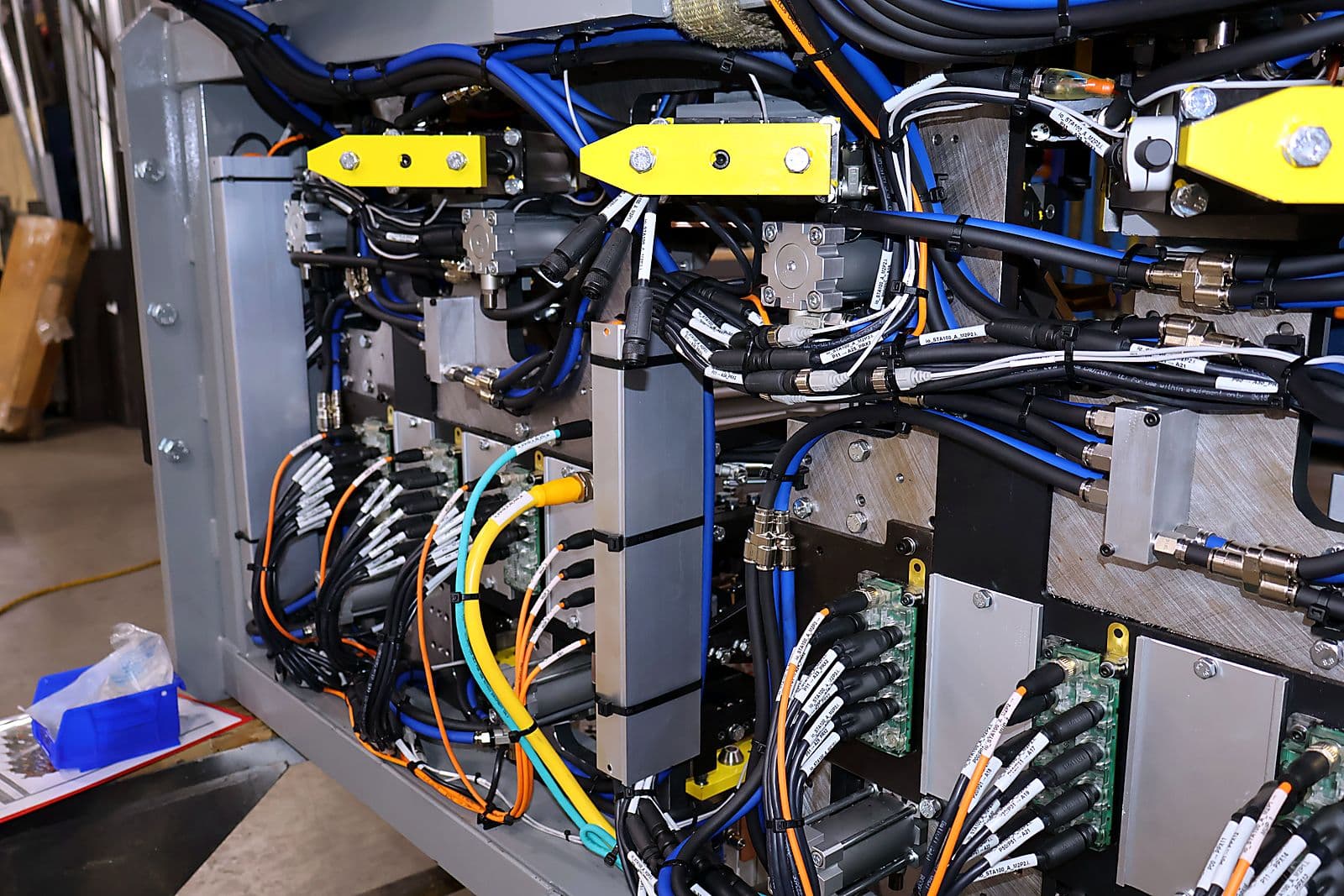
That bookkeeping is invisible and it is most of the controls work. It is also why the finished-goods racks have sensors on them. A cell that knows which bin a part belongs in also has to know whether that bin is there and whether it is full.
What It Actually Did
The cell was designed, built and bought off in under six months from kickoff, working around an inherited structure that had been built for something else.
The requirement was fifty-five seconds, and welding was the constraint. Everything downstream — handling, inspection, marking, packing — could be made to fit around the welding time, but the welding time itself is set by how much metal has to be deposited and how fast an arc can travel while still producing a sound bead. Twelve beads per assembly, six assemblies per cycle, seventy-two welds inside fifty-five seconds. That was the number the whole project had to beat, and it is the one that was beaten.
The proof is on video. At the end of December the welding station was recorded five separate times running at 47, 47, 48, 48 and 48 seconds, against a calculated 47.5. Five consecutive runs on camera, none more than half a second off a figure written down seven months earlier, and all of them comfortably inside the fifty-five the cell was sold against.
The other stations measured out where they needed to: laser marking at 28.54 seconds, the inspection station averaging 54.07 across thirteen consecutive dry cycles. Overall cell cycle at buy-off measured 57 seconds, two over target, with the gap closed against a list of open points at site acceptance a month later.
Six parts out of every fifty-five second cycle. A completed assembly — welded, inspected, marked, packed — every nine seconds.
That is worth stating plainly, because cycle time calculations are routinely wrong by much more than half a second, and because nobody would have known this one was right without somebody standing in front of the cell with a camera recording five cycles back to back.
What Did Not Land Cleanly
The weld inspection was the part of this project that took longest to settle, and it would be dishonest to write around it.
At pre-acceptance the inspection robots were running their motions but the pass and fail result was not making it back to the line. A month later at site acceptance the open points list records, flatly, no change. After that came the physical problems that only show up once a system is moving at production speed: a communication cable rubbing against tooling because the robots moved faster than the cable was rated to flex, calibration that needed revisiting, and full coverage around a bead needing its own round of work. Each became a separate item and the last of them ran well past the end of the project.
Some of that is the nature of robotic weld scanning, which is genuinely hard and is oversold across this industry. Some of it is a sub-system that was integrated before it was proven standing alone. The lesson Ethos took was the second one, and inspection sub-systems on later projects now get proven on their own before they are allowed into a cell.
The rest of the punch list behaved the way a good punch list does. Forty-two items at pre-acceptance: loose fit-up corrected with shims, weld flash contained with extra guarding, spatter build-up on clamps solved with guards and a spatter-resistant coating, a sensor overview screen redesigned so that sensors irrelevant to the running variant grey out instead of confusing the maintenance team. A handling robot clipped an enclosure on the sixteenth of January and was running again on the seventeenth. Most of the list closed inside a month.
The Result That Counts
The cell is in production.
Since it went in, the customer has come back for a second welding cell, for the transfer of tooling onto another line, and for further inspection work. While specifying the second cell, one of their own engineers described what they wanted as identical to this one.
An integrator can write whatever it likes about a project. The only assessment that carries weight is a customer who has seen the machine run for a year and orders the same thing again.