
Shot peening is not a glamorous process. It does not make parts look different, and it does not change their dimensions. What it does is make them last. By blasting metal surfaces with small spherical media at high velocity, shot peening induces compressive residual stress in the material, the same layer of protection that allows landing gear components and structural brackets to endure millions of fatigue cycles over the life of an aircraft.
For one aerospace manufacturer, shot peening was also a bottleneck.
The customer produces structural and closure components for some of the most demanding commercial aviation programs in production. Their shot peen line processed parts across two booths, an OD booth for exterior surfaces and an ID booth for interior surfaces, handling fifteen different part variants across three aircraft programs. Each peening cycle takes several minutes. Some take longer. When the process finished, the part waited. It waited for an operator to come and notice, to stop what they were doing, walk over, unload the finished part, load the next one, and start the cycle again.
In a manual process, that handoff depends entirely on the operator's availability. On a busy floor, parts routinely sat idle between processes, not because the machine was not ready, but because no one was there to move them. The throughput constraint was not cycle time. It was human attention.
Moving the parts was not just slow, it was physically demanding and unsafe. Getting aerospace structural components into the correct orientation for each peening process required two overhead cranes working in tandem, lifting and tilting heavy parts by hand. Every cycle introduced the risk of an unsafe lift, an unsecured load, or an injury. For a facility handling parts destined for commercial aircraft, that risk was unacceptable as a permanent operating condition.
The customer came to Ethos Automation with a direct objective: remove the operator dependency from the peening process entirely. Parts should move continuously and safely, from booth to booth, oriented correctly for each process, without overhead crane lifts, without manual handling, and without waiting for someone to show up. The system should run lights-out once the incoming carts are loaded.
Building the Cell
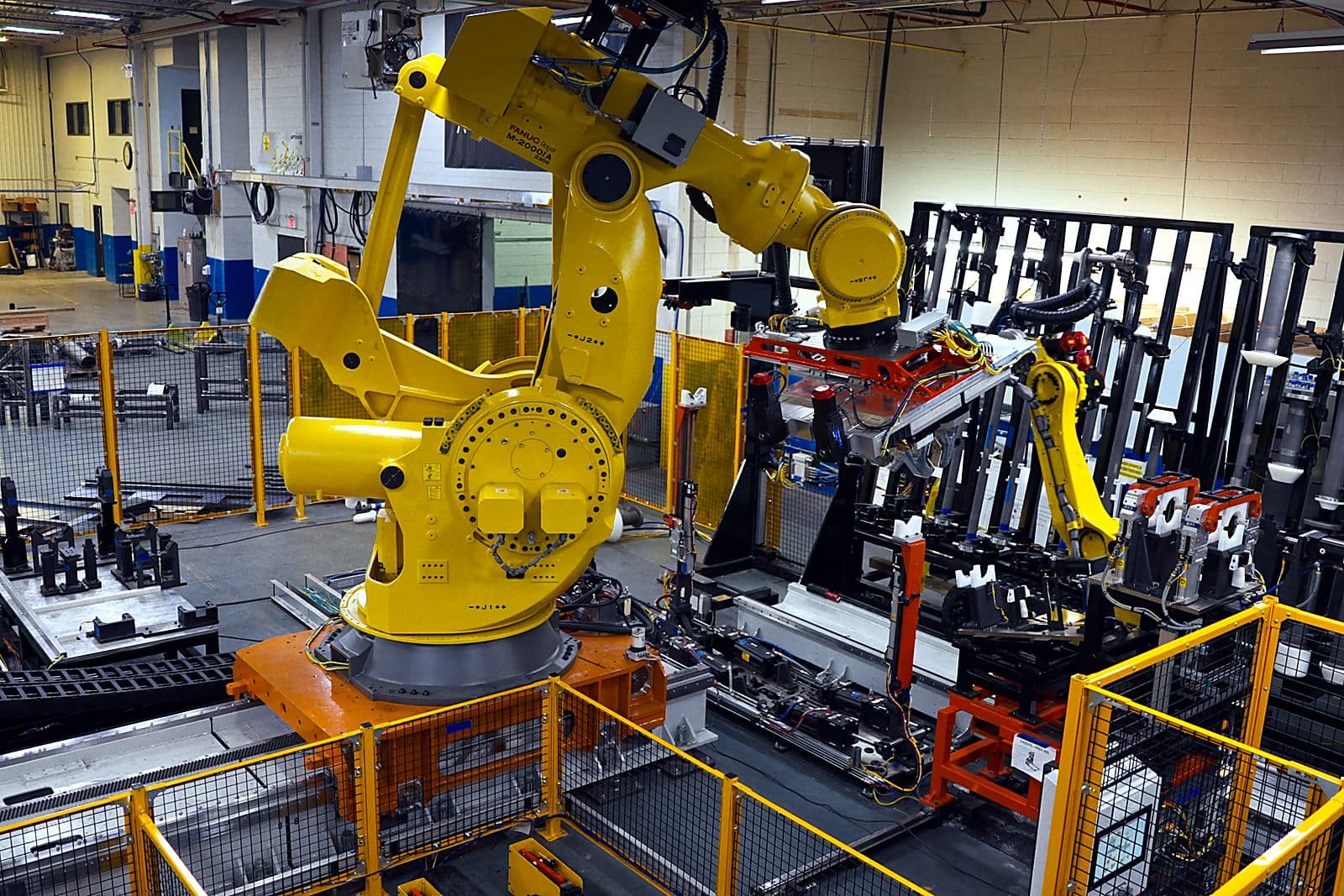
The solution Ethos designed is a fully integrated robotic material handling cell, built around the customer's existing shot peen booths and a tractor-and-conveyor system supplied by the shot peen equipment manufacturer. Three robots handle every step of the process. All three operate from below-floor pits, a deliberate design decision that kept maintenance vehicles and personnel able to access the cell during production, and preserved the customer's ability to intervene manually if needed.
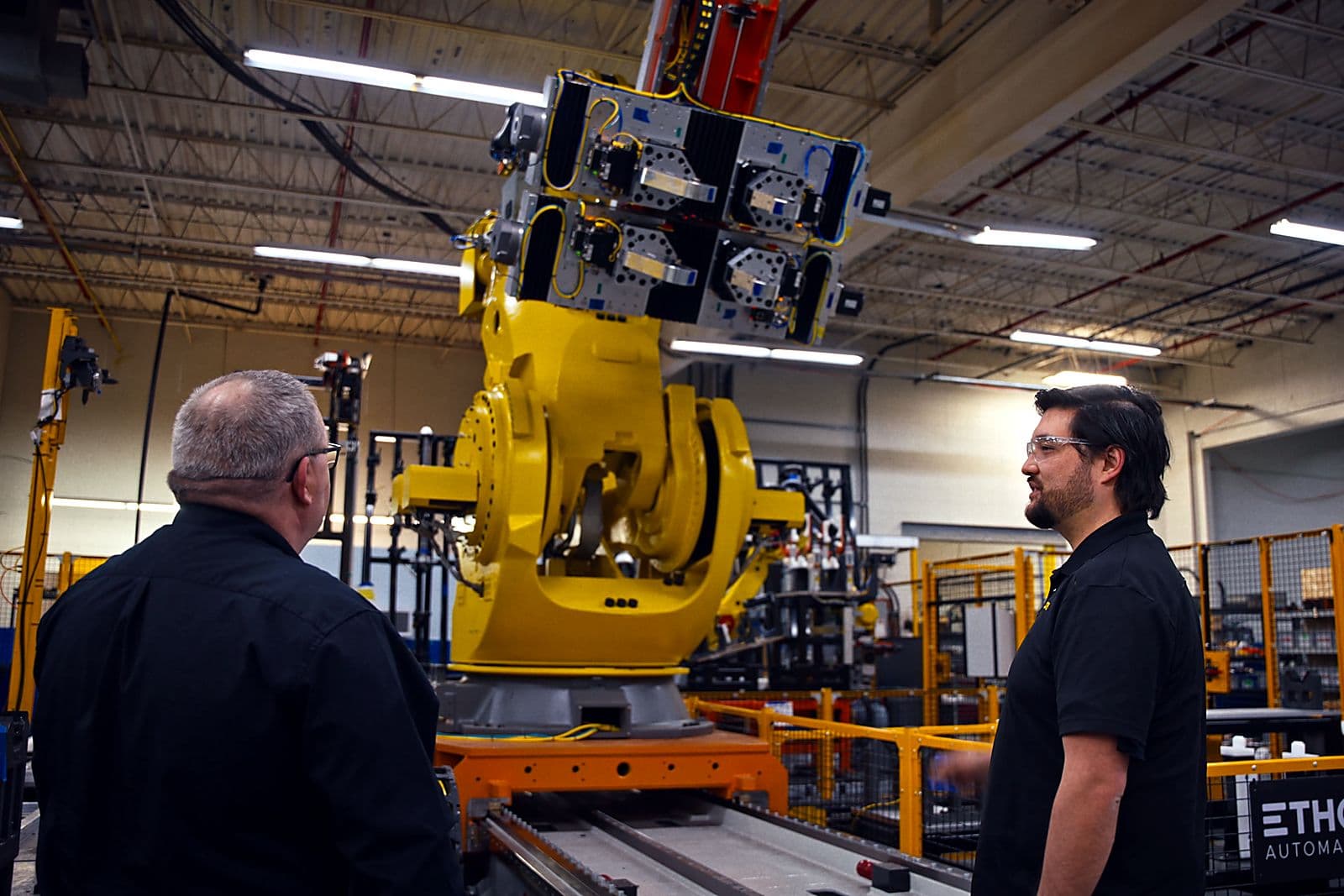
The primary handler is a FANUC M-2000iA/2300, one of the largest payload robots in the world at 2,300 kg (5,070 lb) of rated capacity. Mounted on a seven-axis linear track, it is responsible for picking every landing gear and structural component from the infeed cart stations, moving them between processes, and placing them at each stage of the sequence. The weight class of this robot was not chosen arbitrarily. The aerospace structural components in this cell are heavy, and the reach requirements across the full cell footprint demanded a machine that could move mass at scale without sacrificing positioning accuracy.
That weight class was not what Ethos originally quoted.
The robot in the proposal was too small. The sizing was done against the part data available at the time, and as the design developed it became clear the machine would not carry the heaviest components across the reach the cell actually required. The options at that point are the ones every integrator knows: go back to the customer with a change order, or absorb it.
Ethos upgraded to the larger robot and paid the difference. No change order, no renegotiation.
It is not a comfortable thing to publish, because the underlying fact is that the original estimate was wrong. But a quoting error is Ethos's error, and passing it to a customer who had already committed to a price would have been the wrong way to start a relationship on a cell this critical. The larger machine is also the right machine, which matters more over a decade of production than who paid for it in the first year.
Getting the M-2000iA/2300 into the floor required more than digging a hole. The mass and dynamic loading of a robot this size, accelerating and decelerating with full aerospace parts in its grip through thousands of production cycles, impose structural demands well beyond standard industrial floor specifications. The pit was excavated to six feet (1.8 m) and reinforced throughout with rebar to provide the rigidity needed to absorb the forces this machine generates in operation.
A second robot, a FANUC R-2000iC/210F on its own linear track, handles a different kind of work. Before a landing gear enters its final process and after it exits, the R-2000iC/210F assembles the required tooling fixtures onto the part and removes them afterward. It is a precision operation. The fixtures must go on correctly, in the right orientation, every cycle.
The third robot, a FANUC M-710iC/45M, is stationed inside the ID shot peen booth itself, where it handles part manipulation during the actual peening process, moving the component through the defined shot blast pattern to ensure complete and consistent surface coverage on every part.
Supporting the three robots is a network of stations built to handle the full range of parts and processes: left-hand and right-hand infeed and outfeed cart docking stations, designed from the outset with provisions for future AMR and AGV integration that would make the system fully autonomous end-to-end; mandrel trees holding up to eighteen unique part positions across multiple assemblies; buffer tables for part staging; a dual-bay shot peen nozzle station running eight nozzles per bay; and dedicated tooling stands for each process step. An overhead crane interface, engineered with a dedicated safety zone managed through the cell PLC, allows crane access without requiring the robots to stop.
Ethos's project manager on the job managed the integration across three distinct stakeholders: the aerospace manufacturer as the end customer, the shot peen equipment OEM, and Ethos as the material handling system builder. Three parties were each building their piece of the system at the same time, and making Ethos's robots interface precisely with equipment that was still being designed in parallel was one of the defining challenges from day one.
Mechanical design was led by Ethos's design team lead, with the controls and robotics programming each under their own lead, and technical oversight across the automation architecture from Ethos's chief technical officer.
One Gripper, Sixteen Parts
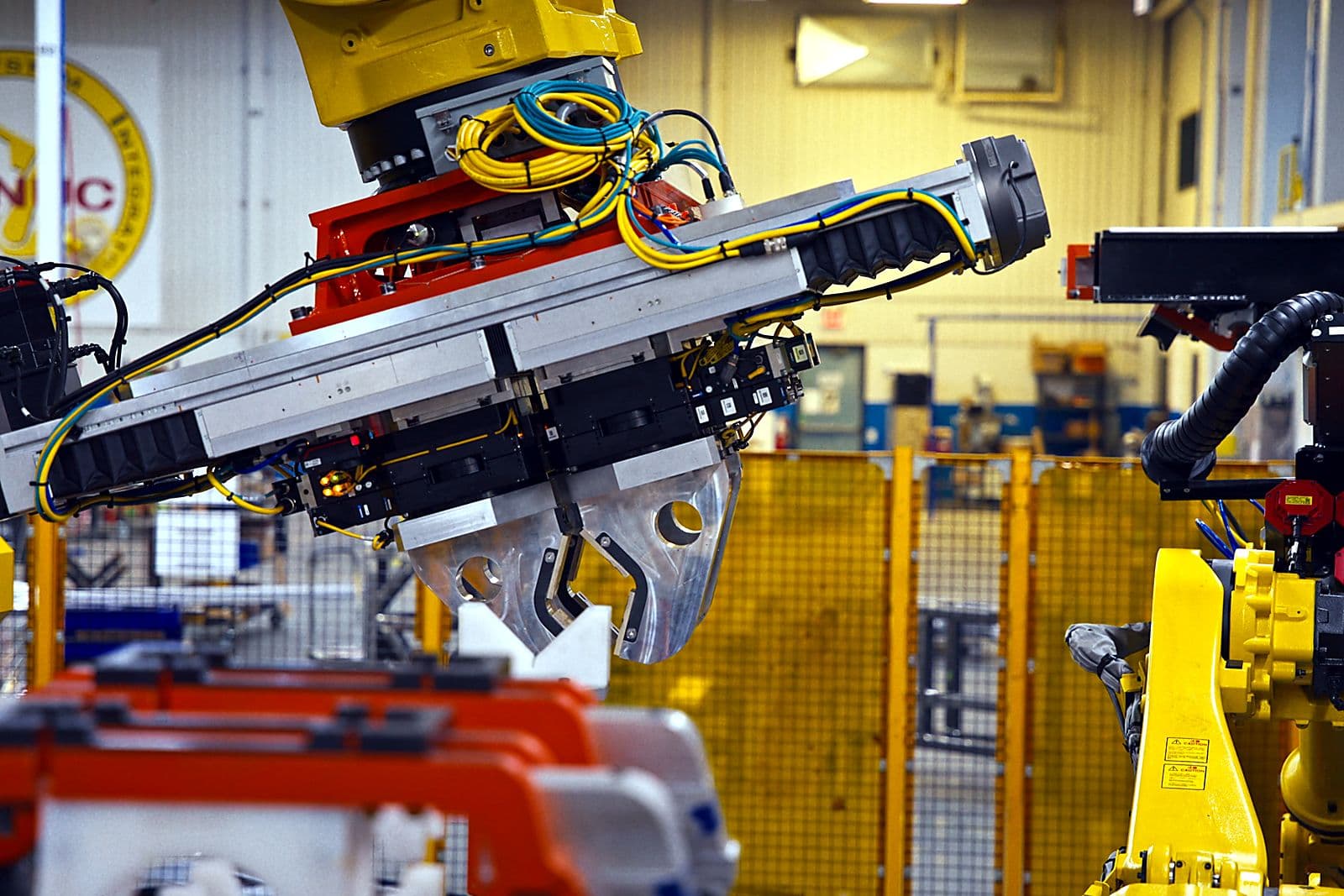
The most constrained element of the mechanical design was the end-of-arm tooling on the M-2000iA/2300. That robot handles every part variant that flows through the cell, sixteen part positions across three aircraft programs, each with different geometry, different weight, and different orientation requirements for the peening process.
The design objective was a single end-of-arm tool that could grip all variants without changeover, at precise angular positions defined for each specific part program. On the M-2000, a robot built to move tonnes, the gripper still had to be accurate enough to present aerospace structural components to the shot peen process at the exact orientation required for each program. Every kilogram added to the tooling reduced the robot's available payload margin for the heaviest parts. Every degree of adjustability in the gripper fingers had to be balanced against the repeatability that aerospace tolerances demand.
Extensive simulation work by Ethos's robotics and simulation specialist drove the reach studies and verified clearances across all part variants before any physical tooling was built. That was a critical step when the cell envelope was being defined around equipment that was still in development on the equipment OEM's side.
The Integration That Kept Changing
The most persistent technical challenge of the project was not the tooling, the pit, or the part variety. It was the tractor.
The equipment OEM's tractor-and-conveyor system moves parts through the interior of the shot peen booth on a driven track. The robot's interface with the tractor had to be defined early. It drove reach studies, end-of-arm tooling design, and cell layout. But the tractor design was still evolving. As the OEM finalized their system, the interface point changed. The original approach had the robot picking from the outside of the tractor mechanism. Midway through the project, the design changed to an inside-grab approach, picking from within the mechanism, similar to how a pull stud engages in a CNC spindle.
The change was the right engineering decision. The inside-grab approach gave more reliable, consistent part presentation and removed external interference from the pick cycle. But it required Ethos to revisit reach studies, adapt the end-of-arm tooling, and revalidate simulation work that had already been completed. When the tractor design changed, it touched almost everything downstream on the Ethos side. The simulation work already done gave the team a structured way to work through the new configuration quickly instead of starting from scratch.
That kind of mid-project ripple is common when multiple parties are building in parallel. Managing it without letting it cascade into the schedule is a project management problem as much as an engineering one. Ethos tracked the interface dependencies across all three parties throughout the project, ensuring that design changes at the equipment OEM surfaced quickly enough for Ethos to adapt before fabrication was locked.
Testing With Live Parts
Proving out a material handling cell for aerospace components requires actual parts. Not prints, not foam mockups, but physical parts from the same programs the machine will run in production.
At the customer's facility, pulling production parts for testing at Ethos meant temporarily removing them from a floor that still had orders to fill. The logistics required careful coordination to secure test pieces without disrupting production. Parts were tracked closely on both sides; some were set aside specifically for Ethos use and held off the production floor. The process of getting parts for every variant, in sufficient quantity to validate all programs, was its own project within the project.
That prove-out phase was where the robot programming came to life against real hardware. Each part variant required verified pick positions, validated orientation sequences, and confirmed clearances, work that simulation can approximate but only live parts can confirm.
Where It Stands
The cell was built, integrated and run off at Ethos's facility in Brantford, where all three robots were proven against live aerospace parts pulled from the customer's own production floor.
Installation at the customer's plant was delayed, and is underway now. That is worth stating plainly rather than skipping past, because it is the ordinary condition of this work. A cell that has to be lowered into reinforced pits in a live aerospace facility, interfaced with a shot peen system built by another party, and commissioned around a production schedule that never stops, does not get installed on the first date anyone writes down. What matters is that the engineering was settled before the equipment left Brantford.
When the cell is handed over, a single operator will bring incoming carts of raw parts to the infeed station and load them. Everything after that is automatic. The M-2000iA/2300 picks each part and moves it through the process sequence. The M-710iC/45M handles the peening inside the ID booth. The R-2000iC/210F assembles and removes the required tooling fixtures. Parts move between processes without waiting, without crane lifts, and without depending on anyone's availability.
The fifteen part variants that once required two overhead cranes and an operator present for every lift will flow through the cell continuously. Across three commercial aircraft programs, the shot peen step stops being a handoff and becomes a flow.
What Comes Next
The infeed and outfeed stations were designed with the step after that already in mind. The cart docking architecture accommodates autonomous mobile robots and AGVs, meaning the single remaining human touchpoint, loading incoming carts, is a deliberate starting point rather than a permanent constraint. When the customer is ready, the system can be extended to true end-to-end lights-out operation without a redesign.